
Ch 31: Alternating Current
Young & Freedman Calc - University Physics 15th Edition
Young & Freedman Calc15th EditionUniversity PhysicsISBN: 9780135159552Not the one you use?Change textbook
Chapter 31, Problem 12 a

You have a 200-Ω resistor, a 0.400-H inductor, and a 6.00-μF capacitor. They are connected to form an L-R-C series circuit. What is the impedance of the circuit?

Verified step by step guidance
1
Step 1: Recall the formula for impedance in an L-R-C series circuit: \( Z = \sqrt{R^2 + (X_L - X_C)^2} \), where \( R \) is the resistance, \( X_L \) is the inductive reactance, and \( X_C \) is the capacitive reactance.
Step 2: Calculate the inductive reactance \( X_L \) using the formula \( X_L = \omega L \), where \( \omega \) is the angular frequency and \( L \) is the inductance. Note that \( \omega = 2\pi f \), where \( f \) is the frequency of the circuit.
Step 3: Calculate the capacitive reactance \( X_C \) using the formula \( X_C = \frac{1}{\omega C} \), where \( C \) is the capacitance and \( \omega \) is the angular frequency.
Step 4: Substitute the values of \( R \), \( X_L \), and \( X_C \) into the impedance formula \( Z = \sqrt{R^2 + (X_L - X_C)^2} \).
Step 5: Simplify the expression to find the impedance \( Z \). Ensure all units are consistent (e.g., convert \( \mu F \) to \( F \) and use SI units for resistance, inductance, and capacitance).

Verified video answer for a similar problem:

This video solution was recommended by our tutors as helpful for the problem above.
Video duration:
2m
Was this helpful?

Key Concepts

Here are the essential concepts you must grasp in order to answer the question correctly.

Impedance in AC Circuits

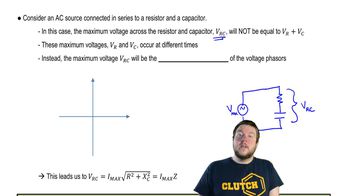
Impedance is the total opposition that a circuit offers to the flow of alternating current (AC) and is represented as a complex number. It combines resistance (R) and reactance (X), where reactance arises from inductors and capacitors. The formula for impedance in an L-R-C series circuit is Z = √(R² + (X_L - X_C)²), where X_L is the inductive reactance and X_C is the capacitive reactance.
Recommended video:
Guided course
08:40
Impedance in AC Circuits

Inductive Reactance

Inductive reactance (X_L) is the opposition to the change of current in an inductor and is given by the formula X_L = 2πfL, where f is the frequency of the AC source and L is the inductance in henries. This reactance increases with frequency, meaning that at higher frequencies, inductors resist changes in current more strongly, affecting the overall impedance of the circuit.
Recommended video:
Guided course
12:59
Mutual Induction

Capacitive Reactance

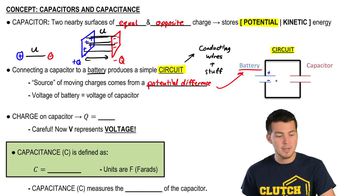
Capacitive reactance (X_C) is the opposition to the change of voltage across a capacitor and is calculated using the formula X_C = 1/(2πfC), where C is the capacitance in farads. Unlike inductive reactance, capacitive reactance decreases with increasing frequency, which means that capacitors allow more current to pass at higher frequencies, influencing the total impedance in the circuit.
Recommended video:
Guided course
08:02
Capacitors & Capacitance (Intro)
Related Practice