
Ch 31: Alternating Current
Young & Freedman Calc - University Physics 15th Edition
Young & Freedman Calc15th EditionUniversity PhysicsISBN: 9780135159552Not the one you use?Change textbook
Chapter 31, Problem 12a

You have a 200-Ω resistor, a 0.400-H inductor, and a 6.00-μF capacitor. Suppose you take the resistor and inductor and make a series circuit with a voltage source that has voltage amplitude 30.0 V and an angular frequency of 250 rad/s. What is the impedance of the circuit?

Verified step by step guidance
1
Start by understanding the concept of impedance in an RLC circuit. Impedance is the total opposition that a circuit presents to the flow of alternating current (AC) and is a combination of resistance (R), inductive reactance (X_L), and capacitive reactance (X_C). In a series RLC circuit, impedance (Z) is given by the formula: Z=R2+(XL-XC)2.
Calculate the inductive reactance (X_L) using the formula: XL=ωL, where ω is the angular frequency and L is the inductance. Substitute the given values: ω=250 rad/s and L=0.400 H.
Calculate the capacitive reactance (X_C) using the formula: XC=1ωC, where C is the capacitance. Substitute the given values: C=6.00×10⁻⁶ F.
Substitute the calculated values of X_L and X_C into the impedance formula: Z=2002+(XL-XC)2.
Finally, simplify the expression to find the impedance Z. Remember that impedance is a complex quantity, but in this case, you are finding its magnitude, which is a real number.

Verified video answer for a similar problem:

This video solution was recommended by our tutors as helpful for the problem above.
Video duration:
1m
Was this helpful?

Key Concepts

Here are the essential concepts you must grasp in order to answer the question correctly.

Impedance in AC Circuits

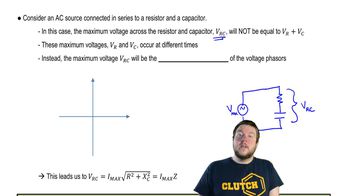
Impedance is the total opposition a circuit offers to the flow of alternating current (AC) and is a combination of resistance and reactance. In a series RLC circuit, impedance (Z) is calculated using Z = √(R² + (X_L - X_C)²), where R is resistance, X_L is inductive reactance, and X_C is capacitive reactance.
Recommended video:
Guided course
08:40
Impedance in AC Circuits

Inductive Reactance

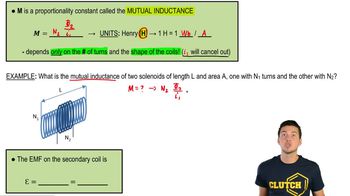
Inductive reactance (X_L) is the opposition to the change in current by an inductor in an AC circuit. It is given by X_L = ωL, where ω is the angular frequency and L is the inductance. It increases with frequency, causing a phase shift between voltage and current.
Recommended video:
Guided course
12:59
Mutual Induction

Angular Frequency

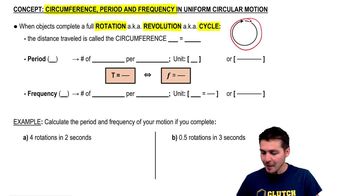
Angular frequency (ω) is a measure of how quickly the AC voltage oscillates, expressed in radians per second. It is related to the frequency (f) by ω = 2πf. Angular frequency is crucial for calculating reactance and impedance in AC circuits, affecting how components like inductors and capacitors behave.
Recommended video:
Guided course
05:08
Circumference, Period, and Frequency in UCM