
Ch 30: Inductance
Young & Freedman Calc - University Physics 15th Edition
Young & Freedman Calc15th EditionUniversity PhysicsISBN: 9780135159552Not the one you use?Change textbook
Chapter 30, Problem 8

When the current in a toroidal solenoid is changing at a rate of 0.0260 A/s, the magnitude of the induced emf is 12.6 mV. When the current equals 1.40 A, the average flux through each turn of the solenoid is 0.00285 Wb. How many turns does the solenoid have?

Verified step by step guidance
1
Identify the given values: rate of change of current (\( \frac{dI}{dt} \)) is 0.0260 A/s, induced emf (\( \mathcal{E} \)) is 12.6 mV or 0.0126 V, current (I) is 1.40 A, and average flux per turn (\( \Phi \)) is 0.00285 Wb.
Use Faraday's Law of Electromagnetic Induction which states \( \mathcal{E} = N \frac{d\Phi}{dt} \), where N is the number of turns in the solenoid and \( \frac{d\Phi}{dt} \) is the rate of change of magnetic flux.
Calculate the total change in flux (\( \frac{d\Phi}{dt} \)) using the relationship between flux and current. Since \( \Phi = N \cdot \phi \) where \( \phi \) is the flux per turn, and the current is changing, use \( \frac{d\Phi}{dt} = N \cdot \frac{d\phi}{dt} \).
Substitute the expression for \( \frac{d\Phi}{dt} \) in terms of \( \frac{dI}{dt} \) and \( \phi \) into Faraday's Law equation. Solve for N by rearranging the equation to isolate N on one side.
Plug in the values for \( \mathcal{E} \), \( \frac{dI}{dt} \), and \( \phi \) to calculate the number of turns, N.

Verified video answer for a similar problem:

This video solution was recommended by our tutors as helpful for the problem above.
Video duration:
2m
Was this helpful?

Key Concepts

Here are the essential concepts you must grasp in order to answer the question correctly.

Faraday's Law of Electromagnetic Induction

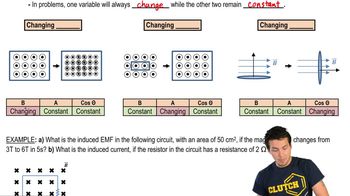
Faraday's Law states that a change in magnetic flux through a circuit induces an electromotive force (emf) in the circuit. The induced emf is proportional to the rate of change of the magnetic flux. In this problem, the changing current in the solenoid leads to a changing magnetic field, which induces an emf according to this principle.
Recommended video:
Guided course
09:26
Faraday's Law

Magnetic Flux

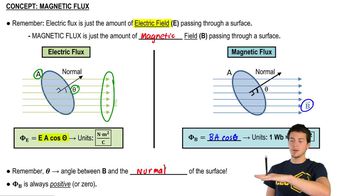
Magnetic flux is a measure of the quantity of magnetism, taking into account the strength and the extent of a magnetic field. It is calculated as the product of the magnetic field and the area through which the field lines pass, perpendicular to the field. In this context, the average flux through each turn of the solenoid is given, which is crucial for determining the number of turns.
Recommended video:
Guided course
04:52
Magnetic Flux

Inductance and Solenoids

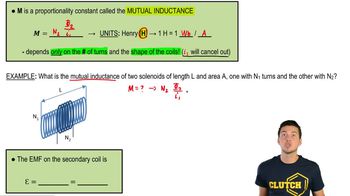
Inductance is a property of an electrical conductor by which a change in current through it induces an emf in the conductor itself and in nearby conductors. A solenoid, a coil of wire, has inductance that depends on its number of turns, the area of the loops, and the core material. Understanding how these factors relate helps in calculating the number of turns in the solenoid.
Recommended video:
Guided course
12:59
Mutual Induction
Related Practice
Textbook Question

The inductor shown in Fig. E30.11 has inductance 0.260 H and carries a current in the direction shown. The current is changing at a constant rate. The potential between points a and b is Vab = 1.04 V, with point a at higher potential. Is the current increasing or decreasing?

1
views
Textbook Question

At the instant when the current in an inductor is increasing at a rate of 0.0640 A/s, the magnitude of the self-induced emf is 0.0160 V. What is the inductance of the inductor?

2
views
Textbook Question

At the instant when the current in an inductor is increasing at a rate of 0.0640 A/s, the magnitude of the self-induced emf is 0.0160 V. If the inductor is a solenoid with 400 turns, what is the average magnetic flux through each turn when the current is 0.720 A?

2
views
Textbook Question

A long, straight solenoid has 800 turns. When the current in the solenoid is 2.90 A, the average flux through each turn of the solenoid is 3.25 × 10⁻³ Wb. What must be the magnitude of the rate of change of the current in order for the self-induced emf to equal 6.20 mV?

1
views
Textbook Question

Inductance of a Solenoid. A metallic laboratory spring is typically 5.00 cm long and 0.150 cm in diameter and has 50 coils. If you connect such a spring in an electric circuit, how much self-inductance must you include for it if you model it as an ideal solenoid?

1
views
Textbook Question

A 2.50-mH toroidal solenoid has an average radius of 6.00 cm and a cross-sectional area of 2.00 cm2. How many coils does it have? (Make the same assumption as in Example 30.3.)

1
views