
Ch 30: Inductance
Young & Freedman Calc - University Physics 15th Edition
Young & Freedman Calc15th EditionUniversity PhysicsISBN: 9780135159552Not the one you use?Change textbook
Chapter 30, Problem 12

A long, straight solenoid has 800 turns. When the current in the solenoid is 2.90 A, the average flux through each turn of the solenoid is 3.25 × 10⁻³ Wb. What must be the magnitude of the rate of change of the current in order for the self-induced emf to equal 6.20 mV?

Verified step by step guidance
1
Start by recalling the formula for the self-induced emf (ε) in a solenoid, which is given by: ε = -N dΦdt, where N is the number of turns, Φ is the magnetic flux, and t is time.
Given that the self-induced emf (ε) is 6.20 mV, convert this value to volts for consistency in units: 6.20 mV = 6.20 × 10^-3 V.
The average flux through each turn of the solenoid is given as 3.25 × 10^-3 Wb. Use this to find the total flux through the solenoid: Φ = N × Φavg, where Φ_avg is the average flux per turn.
Substitute the values into the formula for self-induced emf to find the rate of change of the current: ε = -N dΦdt. Rearrange to solve for dIdt, where I is the current.
Finally, calculate the magnitude of the rate of change of the current using the rearranged formula and the given values. Remember to consider the negative sign in the formula, which indicates the direction of the induced emf relative to the change in current.

Verified video answer for a similar problem:

This video solution was recommended by our tutors as helpful for the problem above.
Video duration:
2m
Was this helpful?

Key Concepts

Here are the essential concepts you must grasp in order to answer the question correctly.

Faraday's Law of Induction

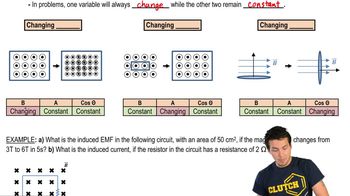
Faraday's Law of Induction states that a change in magnetic flux through a circuit induces an electromotive force (emf) in the circuit. The induced emf is proportional to the rate of change of the magnetic flux. In this problem, the self-induced emf in the solenoid is related to the rate of change of current, which affects the magnetic flux through the solenoid.
Recommended video:
Guided course
09:26
Faraday's Law

Self-Inductance

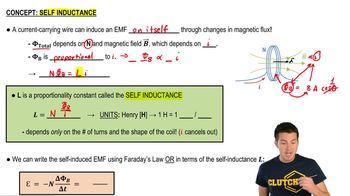
Self-inductance is a property of a solenoid that quantifies its ability to induce an emf in itself due to a change in current. It is determined by the solenoid's geometry and the number of turns. The self-induced emf is given by the product of the self-inductance and the rate of change of current, which is crucial for solving the problem.
Recommended video:
Guided course
07:58
Self Inductance

Magnetic Flux

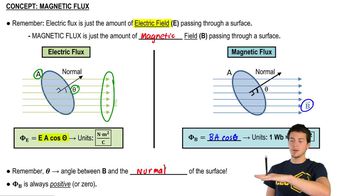
Magnetic flux through a loop is the product of the magnetic field and the area it penetrates, considering the angle between the field and the normal to the area. In a solenoid, the magnetic flux through each turn is affected by the current flowing through it. Understanding how flux changes with current is essential for determining the induced emf in the solenoid.
Recommended video:
Guided course
04:52
Magnetic Flux
Related Practice
Textbook Question

The inductor shown in Fig. E30.11 has inductance 0.260 H and carries a current in the direction shown. The current is changing at a constant rate. The potential between points a and b is Vab = 1.04 V, with point a at higher potential. Is the current increasing or decreasing?

1
views
Textbook Question

It has been proposed to use large inductors as energy storage devices. How much electrical energy is converted to light and thermal energy by a 150 W light bulb in one day?

8
views
Textbook Question

An air-filled toroidal solenoid has a mean radius of 15.0 cm and a cross-sectional area of 5.00 cm2. When the current is 12.0 A, the energy stored is 0.390 J. How many turns does the winding have?

Textbook Question

When the current in a toroidal solenoid is changing at a rate of 0.0260 A/s, the magnitude of the induced emf is 12.6 mV. When the current equals 1.40 A, the average flux through each turn of the solenoid is 0.00285 Wb. How many turns does the solenoid have?

2
views
Textbook Question

Inductance of a Solenoid. A metallic laboratory spring is typically 5.00 cm long and 0.150 cm in diameter and has 50 coils. If you connect such a spring in an electric circuit, how much self-inductance must you include for it if you model it as an ideal solenoid?

1
views
Textbook Question

A solenoid 25.0 cm long and with a cross-sectional area of 0.500 cm2 contains 400 turns of wire and carries a current of 80.0 A. Calculate: the total energy contained in the coil's magnetic field (assume the field is uniform);

1
views