

The inductor shown in Fig. E30.11 has inductance 0.260 H and carries a current in the direction shown. The current is changing at a constant rate. The potential between points a and b is Vab = 1.04 V, with point a at higher potential. Is the current increasing or decreasing?
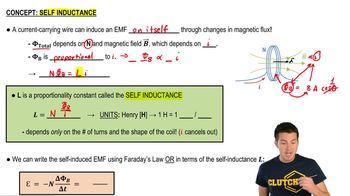
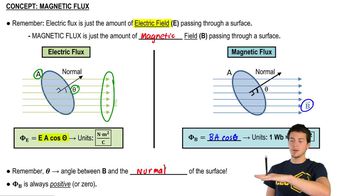
At the instant when the current in an inductor is increasing at a rate of 0.0640 A/s, the magnitude of the self-induced emf is 0.0160 V. If the inductor is a solenoid with 400 turns, what is the average magnetic flux through each turn when the current is 0.720 A?
Verified step by step guidance
Verified video answer for a similar problem:
Key Concepts
Inductance and Self-Induced EMF
Magnetic Flux
Solenoid and Its Magnetic Field
At the instant when the current in an inductor is increasing at a rate of 0.0640 A/s, the magnitude of the self-induced emf is 0.0160 V. What is the inductance of the inductor?
Two coils have mutual inductance M = 3.25 × 10⁻⁴ H. The current i1 in the first coil increases at a uniform rate of 830 A/s. What is the magnitude of the induced emf in the second coil? Is it constant?
When the current in a toroidal solenoid is changing at a rate of 0.0260 A/s, the magnitude of the induced emf is 12.6 mV. When the current equals 1.40 A, the average flux through each turn of the solenoid is 0.00285 Wb. How many turns does the solenoid have?
Inductance of a Solenoid. A metallic laboratory spring is typically 5.00 cm long and 0.150 cm in diameter and has 50 coils. If you connect such a spring in an electric circuit, how much self-inductance must you include for it if you model it as an ideal solenoid?
A 2.50-mH toroidal solenoid has an average radius of 6.00 cm and a cross-sectional area of 2.00 cm2. How many coils does it have? (Make the same assumption as in Example 30.3.)
