
Ch 21: Electric Charge and Electric Field
Young & Freedman Calc - University Physics 15th Edition
Young & Freedman Calc15th EditionUniversity PhysicsISBN: 9780135159552Not the one you use?Change textbook
Chapter 21, Problem 53b

An electric dipole with dipole moment p p is in a uniform external electric field EE. Which of the orientations in part (a) is stable, and which is unstable? (Hint: Consider a small rotation away from the equilibrium position and see what happens.) Note: Part (a) asked to find the orientations of the dipole for which the torque on the dipole is zero.

Verified step by step guidance
1
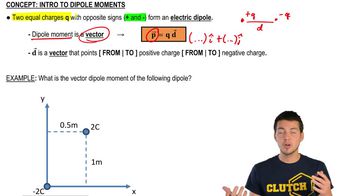
Understand the concept of an electric dipole: An electric dipole consists of two equal and opposite charges separated by a distance. The dipole moment \( \mathbf{p} \) is a vector quantity defined as \( \mathbf{p} = q \cdot \mathbf{d} \), where \( q \) is the charge and \( \mathbf{d} \) is the displacement vector from the negative to the positive charge.
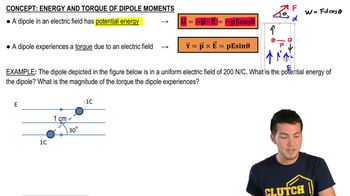
Recognize the effect of an electric field on a dipole: When placed in a uniform electric field \( \mathbf{E} \), a dipole experiences a torque \( \tau \) given by \( \tau = \mathbf{p} \times \mathbf{E} \). This torque tends to align the dipole with the electric field.
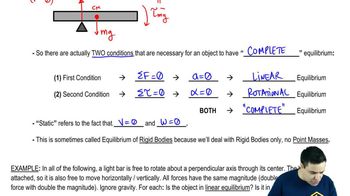
Identify stable and unstable equilibrium: A stable equilibrium occurs when a small displacement results in a restoring torque that returns the dipole to its original position. An unstable equilibrium occurs when a small displacement results in a torque that further displaces the dipole.
Analyze the orientations: In part (a), the dipole can be aligned parallel or antiparallel to the electric field. When the dipole is parallel to the field (\( \mathbf{p} \) and \( \mathbf{E} \) in the same direction), any small rotation will result in a restoring torque, indicating a stable equilibrium. When the dipole is antiparallel (\( \mathbf{p} \) and \( \mathbf{E} \) in opposite directions), a small rotation will result in a torque that increases the displacement, indicating an unstable equilibrium.
Conclude the stability: The stable orientation is when the dipole is aligned parallel to the electric field, and the unstable orientation is when it is aligned antiparallel. This conclusion is based on the behavior of the torque in response to small displacements from these positions.

Verified video answer for a similar problem:

This video solution was recommended by our tutors as helpful for the problem above.
Video duration:
4m
Was this helpful?

Key Concepts

Here are the essential concepts you must grasp in order to answer the question correctly.

Electric Dipole Moment

The electric dipole moment is a vector quantity that represents the separation of positive and negative charges within a system. It is defined as the product of the charge magnitude and the distance between the charges, pointing from the negative to the positive charge. In an electric field, the dipole moment determines the torque experienced by the dipole.
Recommended video:
Guided course
03:08
Intro To Dipole Moment

Torque on a Dipole

Torque on a dipole in an electric field is the rotational force experienced by the dipole due to the field. It is given by the cross product of the dipole moment and the electric field vector, τ = p × E. This torque tends to align the dipole moment with the electric field, influencing the dipole's orientation and stability.
Recommended video:
Guided course
05:19
Energy & Torque of Dipole Moments

Stable and Unstable Equilibrium

Stable equilibrium occurs when a system returns to its equilibrium position after a small disturbance, while unstable equilibrium leads to further deviation from the equilibrium. For a dipole in an electric field, stability is determined by the orientation of the dipole moment relative to the field; aligned dipoles are stable, whereas anti-aligned dipoles are unstable.
Recommended video:
Guided course
10:13
Torque & Equilibrium
Related Practice
Textbook Question

An electric dipole with dipole moment p p is in a uniform external electric field EE. Show that for the stable orientation in part (b), the dipole's own electric field tends to oppose the external field. Note: Part (b) asked which of the orientations in part (a) is stable, and which is unstable? (Hint: Consider a small rotation away from the equilibrium position and see what happens.) Also, part (a) asked to find the orientations of the dipole for which the torque on the dipole is zero.

1
views
Textbook Question

The dipole moment of the water molecule (H2O) is 6.17×10306.17\(\times\)10^{-30} Cm. Consider a water molecule located at the origin whose dipole moment pp points in the +x+x-direction. A chlorine ion (Cl-), of charge 1.60×10¹⁹-1.60\(\times\)10^{-19} C, is located at x=3.00×10⁹x=3.00\(\times\)10^{-9} m. Find the magnitude and direction of the electric force that the water molecule exerts on the chlorine ion. Is this force attractive or repulsive? Assume that xx is much larger than the separation dd between the charges in the dipole, so that the approximate expression for the electric field along the dipole axis derived in Example 21.1421.14 can be used.

1
views
Textbook Question

Point charges q1=4.5q_1=-4.5 nC and q2=+4.5q_2=+4.5 nC are separated by 3.13.1 mm, forming an electric dipole. The charges are in a uniform electric field whose direction makes an angle of 36.936.9° with the line connecting the charges. What is the magnitude of this field if the torque exerted on the dipole has magnitude 7.2×1097.2\(\times\)10^{-9} Nm?

1
views
Textbook Question

An electric dipole with dipole moment p p is in a uniform external electric field EE. Find the orientations of the dipole for which the torque on the dipole is zero.

1
views
Textbook Question

A very long, straight wire has charge per unit length 3.20×10103.20\(\times\)10^{-10} C/m. At what distance from the wire is the electric field magnitude equal to 2.502.50 N/C?