
Ch 21: Electric Charge and Electric Field
Young & Freedman Calc - University Physics 15th Edition
Young & Freedman Calc15th EditionUniversity PhysicsISBN: 9780135159552Not the one you use?Change textbook
Chapter 21, Problem 54

The dipole moment of the water molecule (H2O) is 6.17×10306.17\(\times\)10^{-30} Cm. Consider a water molecule located at the origin whose dipole moment pp points in the +x+x-direction. A chlorine ion (Cl-), of charge 1.60×10¹⁹-1.60\(\times\)10^{-19} C, is located at x=3.00×10⁹x=3.00\(\times\)10^{-9} m. Find the magnitude and direction of the electric force that the water molecule exerts on the chlorine ion. Is this force attractive or repulsive? Assume that xx is much larger than the separation dd between the charges in the dipole, so that the approximate expression for the electric field along the dipole axis derived in Example 21.1421.14 can be used.

Verified step by step guidance
1
Step 1: Understand the problem setup. The water molecule has a dipole moment pointing in the +x direction, and the chlorine ion is located at a distance x = 3.00×10^{-9} m along the x-axis. The goal is to calculate the magnitude and direction of the electric force exerted by the dipole on the ion, and determine whether the force is attractive or repulsive.
Step 2: Recall the approximate expression for the electric field along the axis of a dipole. For a point along the dipole axis at a distance x (where x >> d, the separation between charges in the dipole), the electric field is given by: Ex=2px3, where p is the dipole moment and x is the distance from the dipole.
Step 3: Substitute the given values into the formula for the electric field. The dipole moment p = 6.17×10^{-30} Cm, and the distance x = 3.00×10^{-9} m. Plug these values into the formula to calculate the electric field at the location of the chlorine ion.
Step 4: Use the relationship between electric field and force to calculate the force on the chlorine ion. The force is given by: F=qE, where q is the charge of the chlorine ion (-1.60×10^{-19} C) and E is the electric field calculated in the previous step.
Step 5: Determine the direction and nature of the force. Since the chlorine ion has a negative charge and the dipole moment points in the +x direction, the electric field will attract the negative charge toward the dipole. Thus, the force is attractive and directed toward the origin (negative x direction).

Verified video answer for a similar problem:

This video solution was recommended by our tutors as helpful for the problem above.
Was this helpful?

Key Concepts

Here are the essential concepts you must grasp in order to answer the question correctly.

Dipole Moment

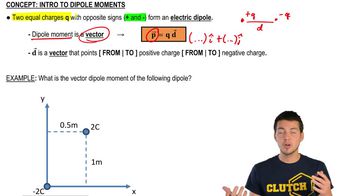
The dipole moment is a vector quantity that represents the separation of positive and negative charges in a system. For a molecule like water (H2O), it indicates the strength and direction of the dipole, which arises due to the difference in electronegativity between hydrogen and oxygen. The dipole moment is crucial for understanding how polar molecules interact with electric fields and other charges.
Recommended video:
Guided course
03:08
Intro To Dipole Moment

Electric Field of a Dipole

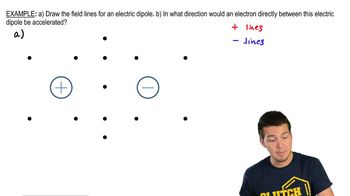
The electric field generated by a dipole decreases with distance and is directed along the dipole axis. For points far from the dipole, the electric field can be approximated using a specific formula that accounts for the dipole moment and the distance from the dipole. This concept is essential for calculating the force exerted by the dipole on other charges, such as the chlorine ion in this scenario.
Recommended video:
Guided course
08:20
Electric Field Lines

Coulomb's Law

Coulomb's Law describes the force between two point charges, stating that the force is proportional to the product of the magnitudes of the charges and inversely proportional to the square of the distance between them. This law is fundamental in determining the nature of the interaction (attractive or repulsive) between the dipole and the chlorine ion, based on their respective charges.
Recommended video:
Guided course
09:52
Coulomb's Law