
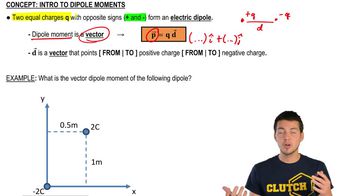
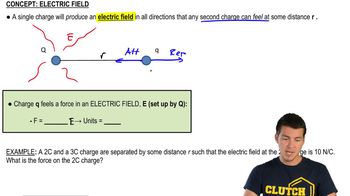
An electric dipole with dipole moment is in a uniform external electric field . Show that for the stable orientation in part (b), the dipole's own electric field tends to oppose the external field. Note: Part (b) asked which of the orientations in part (a) is stable, and which is unstable? (Hint: Consider a small rotation away from the equilibrium position and see what happens.) Also, part (a) asked to find the orientations of the dipole for which the torque on the dipole is zero.
An electric dipole with dipole moment is in a uniform external electric field . Find the orientations of the dipole for which the torque on the dipole is zero.
Verified step by step guidance
Verified video answer for a similar problem:
Key Concepts
Electric Dipole Moment
Torque in Electric Fields
Equilibrium Orientation
A point charge nC is at the point m, m, and a second point charge nC is at the point m, . Calculate the magnitude and direction of the net electric field at the origin due to these two point charges.
The dipole moment of the water molecule (H2O) is Cm. Consider a water molecule located at the origin whose dipole moment points in the -direction. A chlorine ion (Cl-), of charge C, is located at m. Find the magnitude and direction of the electric force that the water molecule exerts on the chlorine ion. Is this force attractive or repulsive? Assume that is much larger than the separation between the charges in the dipole, so that the approximate expression for the electric field along the dipole axis derived in Example can be used.
Point charges nC and nC are separated by mm, forming an electric dipole. The charges are in a uniform electric field whose direction makes an angle of ° with the line connecting the charges. What is the magnitude of this field if the torque exerted on the dipole has magnitude Nm?
An electric dipole with dipole moment is in a uniform external electric field . Which of the orientations in part (a) is stable, and which is unstable? (Hint: Consider a small rotation away from the equilibrium position and see what happens.) Note: Part (a) asked to find the orientations of the dipole for which the torque on the dipole is zero.
A very long, straight wire has charge per unit length C/m. At what distance from the wire is the electric field magnitude equal to N/C?
