Ch 21: Electric Charge and Electric Field
Young & Freedman Calc - University Physics 15th Edition
Young & Freedman Calc15th EditionUniversity PhysicsISBN: 9780135159552Not the one you use?Change textbook
Chapter 21, Problem 48

A very long, straight wire has charge per unit length 3.20×10103.20\(\times\)10^{-10} C/m. At what distance from the wire is the electric field magnitude equal to 2.502.50 N/C?

Verified step by step guidance
1
First, recognize that the problem involves a long, straight wire with a uniform linear charge density, which suggests using Gauss's Law to find the electric field around the wire.
Gauss's Law states that the electric flux through a closed surface is equal to the charge enclosed divided by the permittivity of free space: Φ=Qε0.
For a long, straight wire, consider a cylindrical Gaussian surface coaxial with the wire. The electric field is radial and constant over the curved surface of the cylinder.
The electric field magnitude E at a distance r from the wire is given by: E=λ2πrε0, where λ is the linear charge density.
Set the given electric field magnitude 2.50 N/C equal to the expression for E and solve for r: r=λ2πε0E. Substitute the values for λ, ε0, and E to find r.

Verified video answer for a similar problem:

This video solution was recommended by our tutors as helpful for the problem above.
Video duration:
5m
Was this helpful?

Key Concepts

Here are the essential concepts you must grasp in order to answer the question correctly.

Linear Charge Density

Linear charge density is the amount of electric charge per unit length along a wire or line. It is denoted by λ and is measured in coulombs per meter (C/m). In this problem, the wire has a linear charge density of 3.20 * 10^-10 C/m, which is crucial for calculating the electric field around the wire.
Recommended video:
Guided course
8:13
Intro to Density

Electric Field due to a Line of Charge

The electric field generated by a long, straight wire with uniform linear charge density can be calculated using Gauss's Law. The electric field (E) at a distance (r) from the wire is given by E = (λ / (2πε₀r)), where ε₀ is the permittivity of free space. This formula helps determine the distance at which the electric field magnitude is specified.
Recommended video:
Guided course
08:20
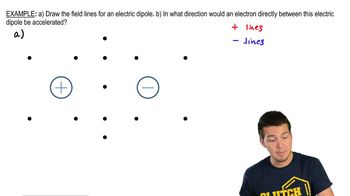
Electric Field Lines

Permittivity of Free Space

Permittivity of free space, denoted as ε₀, is a fundamental physical constant that describes how electric fields interact with the vacuum. Its value is approximately 8.85 * 10^-12 C²/(N·m²). This constant is essential in calculating the electric field around charged objects, such as the wire in this problem, using Gauss's Law.
Recommended video:
Guided course
5:05
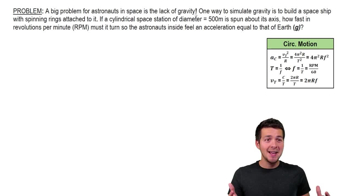
Spinning Space Station
Related Practice
Textbook Question

A point charge q1=4.00q_1=-4.00 nC is at the point x=0.600x = 0.600 m, y=0.800y = 0.800 m, and a second point charge q2=+6.00q_2=+6.00 nC is at the point x=0.600x = 0.600 m, y=0y = 0. Calculate the magnitude and direction of the net electric field at the origin due to these two point charges.

Textbook Question

A point charge is placed at each corner of a square with side length aa. All charges have magnitude qq. Two of the charges are positive and two are negative (Fig. E21.4221.42). What is the direction of the net electric field at the center of the square due to the four charges, and what is its magnitude in terms of qq and aa?

Textbook Question

Point charges q1=4.5q_1=-4.5 nC and q2=+4.5q_2=+4.5 nC are separated by 3.13.1 mm, forming an electric dipole. The charges are in a uniform electric field whose direction makes an angle of 36.936.9° with the line connecting the charges. What is the magnitude of this field if the torque exerted on the dipole has magnitude 7.2×1097.2\(\times\)10^{-9} Nm?

1
views
Textbook Question

An electric dipole with dipole moment p p is in a uniform external electric field EE. Find the orientations of the dipole for which the torque on the dipole is zero.

1
views
Textbook Question

An electric dipole with dipole moment p p is in a uniform external electric field EE. Which of the orientations in part (a) is stable, and which is unstable? (Hint: Consider a small rotation away from the equilibrium position and see what happens.) Note: Part (a) asked to find the orientations of the dipole for which the torque on the dipole is zero.

2
views
Textbook Question

A 4.00-4.00-nC point charge is at the origin, and a second 5.00-5.00-nC point charge is on the xx-axis at x=0.800x = 0.800 m. Find the net electric force that the two charges would exert on an electron placed at each point in part (a). Note: Part (a) asked to find the electric field (magnitude and direction) at each of the following points on the xx-axis: (i) x=0.200x = 0.200 m; (ii) x=1.20x = 1.20 m; (iii) x=0.200x = -0.200 m.

1
views