
Ch 18: Thermal Properties of Matter
Young & Freedman Calc - University Physics 15th Edition
Young & Freedman Calc15th EditionUniversity PhysicsISBN: 9780135159552Not the one you use?Change textbook
Chapter 18, Problem 37b

How much heat does it take to increase the temperature of 1.801.80 mol of an ideal gas by 50.050.0 K near room temperature if the gas is held at constant volume and is monatomic?

Verified step by step guidance
1
Identify the formula for calculating the heat required to change the temperature of an ideal gas at constant volume. The formula is: Q = nCvΔT, where Q is the heat added, n is the number of moles, Cv is the molar heat capacity at constant volume, and ΔT is the change in temperature.
Determine the molar heat capacity at constant volume for a monatomic ideal gas. For a monatomic gas, Cv = rac{3}{2}R, where R is the universal gas constant, approximately 8.314 J/(mol·K).
Substitute the given values into the formula. You have n = 1.80 mol, ΔT = 50.0 K, and Cv = rac{3}{2}R. The equation becomes: Q = 1.80 imes rac{3}{2} imes 8.314 imes 50.0.
Perform the multiplication step by step. First, calculate rac{3}{2} imes 8.314, then multiply the result by 1.80, and finally multiply by 50.0.
Ensure the units are consistent throughout the calculation. The result will be in joules (J), as the universal gas constant R is in J/(mol·K) and the temperature change is in Kelvin (K).

Verified video answer for a similar problem:

This video solution was recommended by our tutors as helpful for the problem above.
Video duration:
1m
Was this helpful?

Key Concepts

Here are the essential concepts you must grasp in order to answer the question correctly.

Ideal Gas Law

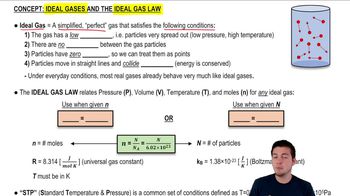
The Ideal Gas Law is a fundamental equation in thermodynamics that relates the pressure, volume, temperature, and number of moles of an ideal gas. It is expressed as PV = nRT, where P is pressure, V is volume, n is the number of moles, R is the ideal gas constant, and T is temperature. This law helps in understanding the behavior of gases under different conditions.
Recommended video:
Guided course
07:21
Ideal Gases and the Ideal Gas Law

Specific Heat Capacity at Constant Volume (Cv)

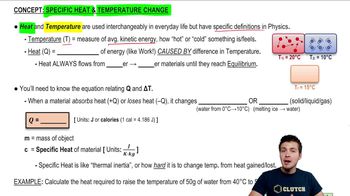
Specific heat capacity at constant volume (Cv) is the amount of heat required to raise the temperature of a unit quantity of a substance by one degree Celsius while keeping the volume constant. For a monatomic ideal gas, Cv is given by (3/2)R, where R is the ideal gas constant. This concept is crucial for calculating the heat needed to change the temperature of a gas at constant volume.
Recommended video:
Guided course
06:50
Specific Heat & Temperature Changes

Heat Transfer in Thermodynamics

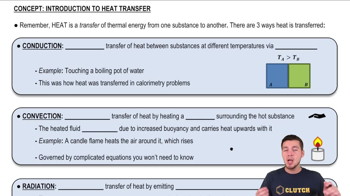
Heat transfer in thermodynamics refers to the process of energy exchange between systems due to temperature difference. In the context of gases, the heat transferred can be calculated using the formula Q = nCvΔT, where Q is the heat added, n is the number of moles, Cv is the specific heat capacity at constant volume, and ΔT is the change in temperature. This formula is essential for determining the heat required to change the temperature of a gas.
Recommended video:
Guided course
05:14
Overview of Heat Transfer