Ch 18: Thermal Properties of Matter
Young & Freedman Calc - University Physics 15th Edition
Young & Freedman Calc15th EditionUniversity PhysicsISBN: 9780135159552Not the one you use?Change textbook
Chapter 18, Problem 34a

Smoke particles in the air typically have masses of the order of 101610^{-16} kg. The Brownian motion (rapid, irregular movement) of these particles, resulting from collisions with air molecules, can be observed with a microscope. Find the root-mean-square speed of Brownian motion for a particle with a mass of 3.00×10163.00\(\times\)10^{-16} kg in air at 300300 K.

Verified step by step guidance
1
Start by understanding the concept of root-mean-square speed, which is a measure of the average speed of particles in a gas. It is derived from the kinetic theory of gases.
Use the formula for root-mean-square speed: 3kTm, where k is the Boltzmann constant (1.38×10⁻²³J·K-1), T is the temperature in Kelvin, and m is the mass of the particle.
Substitute the given values into the formula: 3×1.38×10-23·3003.00×10-16.
Calculate the numerator: 3×1.38×10-23·300, which represents the product of three constants and the temperature.
Calculate the root-mean-square speed by taking the square root of the fraction obtained from the previous steps, which involves dividing the calculated numerator by the mass of the particle.

Verified video answer for a similar problem:

This video solution was recommended by our tutors as helpful for the problem above.
Video duration:
3m
Was this helpful?

Key Concepts

Here are the essential concepts you must grasp in order to answer the question correctly.

Brownian Motion

Brownian motion refers to the random movement of particles suspended in a fluid, resulting from collisions with fast-moving molecules in the fluid. This phenomenon is crucial for understanding the behavior of smoke particles in air, as it explains their rapid and irregular motion observed under a microscope.
Recommended video:

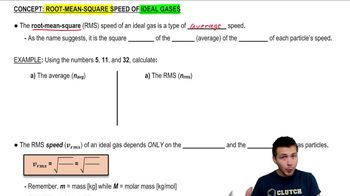
Root-Mean-Square Speed

The root-mean-square speed is a measure of the average speed of particles in a gas, derived from the kinetic theory of gases. It is calculated using the formula v_rms = sqrt((3kT)/m), where k is the Boltzmann constant, T is the temperature, and m is the mass of the particle. This concept helps quantify the speed of Brownian motion for smoke particles.
Recommended video:
Guided course
05:21
Root-Mean-Square Speed of Ideal Gases

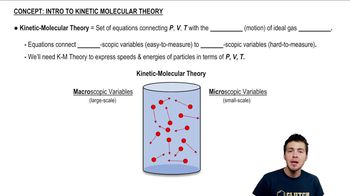
Kinetic Theory of Gases

The kinetic theory of gases explains the macroscopic properties of gases by considering their molecular composition and motion. It provides the basis for calculating the root-mean-square speed, as it relates temperature and particle mass to the average kinetic energy, essential for understanding the dynamics of particles like those in Brownian motion.
Recommended video:
Guided course
01:50
Introduction to Kinetic-Molecular Theory