
Ch 18: Thermal Properties of Matter
Young & Freedman Calc - University Physics 15th Edition
Young & Freedman Calc15th EditionUniversity PhysicsISBN: 9780135159552Not the one you use?Change textbook
Chapter 18, Problem 37a

How much heat does it take to increase the temperature of 1.801.80 mol of an ideal gas by 50.050.0 K near room temperature if the gas is held at constant volume and is diatomic?

Verified step by step guidance
1
Identify the formula for calculating the heat required to change the temperature of an ideal gas at constant volume. This is given by the equation: Q = nCvΔT, where Q is the heat added, n is the number of moles, Cv is the molar heat capacity at constant volume, and ΔT is the change in temperature.
Determine the molar heat capacity at constant volume for a diatomic ideal gas. For diatomic gases, Cv is typically 5/2R, where R is the universal gas constant, approximately 8.314 J/molK.
Substitute the known values into the formula. You have n = 1.80 mol, Cv = 5/2R, and ΔT = 50.0 K. Plug these values into the equation: Q = 1.80 mol × 5/2 × 8.314 J/molK × 50.0 K.
Simplify the expression by performing the multiplication step by step. First, calculate 5/2 × 8.314, then multiply the result by 50.0, and finally multiply by 1.80.
Interpret the result. The calculated value of Q will give you the amount of heat required in joules to increase the temperature of the diatomic gas by 50.0 K at constant volume.

Verified video answer for a similar problem:

This video solution was recommended by our tutors as helpful for the problem above.
Video duration:
1m
Was this helpful?

Key Concepts

Here are the essential concepts you must grasp in order to answer the question correctly.

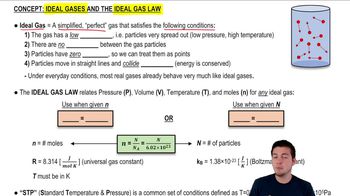
Ideal Gas Law

The Ideal Gas Law is a fundamental equation in thermodynamics, expressed as PV = nRT, where P is pressure, V is volume, n is the number of moles, R is the ideal gas constant, and T is temperature. It describes the behavior of an ideal gas, allowing us to relate changes in temperature to changes in other properties when the gas is held at constant volume.
Recommended video:
Guided course
07:21
Ideal Gases and the Ideal Gas Law

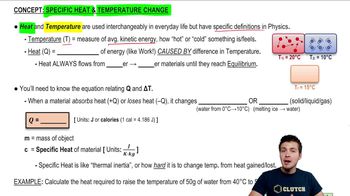
Specific Heat Capacity at Constant Volume (Cv)

Specific heat capacity at constant volume (Cv) is the amount of heat required to raise the temperature of a unit quantity of a substance by one degree Celsius while keeping the volume constant. For diatomic gases, Cv is typically higher than for monatomic gases due to additional degrees of freedom, such as rotational motion, which absorb energy.
Recommended video:
Guided course
06:50
Specific Heat & Temperature Changes

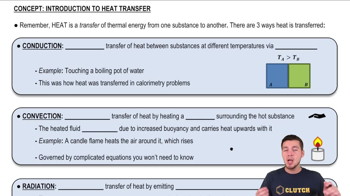
Heat Transfer in Thermodynamics

Heat transfer in thermodynamics involves the movement of thermal energy from one body or system to another. In this context, the heat required to change the temperature of a gas can be calculated using the formula Q = nCvΔT, where Q is the heat added, n is the number of moles, Cv is the specific heat capacity at constant volume, and ΔT is the change in temperature.
Recommended video:
Guided course
05:14
Overview of Heat Transfer
Related Practice
Textbook Question

Smoke particles in the air typically have masses of the order of 101610^{-16} kg. The Brownian motion (rapid, irregular movement) of these particles, resulting from collisions with air molecules, can be observed with a microscope. Find the root-mean-square speed of Brownian motion for a particle with a mass of 3.00×10163.00\(\times\)10^{-16} kg in air at 300300 K.

1
views
Textbook Question

How much heat does it take to increase the temperature of 1.801.80 mol of an ideal gas by 50.050.0 K near room temperature if the gas is held at constant volume and is monatomic?

1
views
Textbook Question

For diatomic carbon dioxide gas (CO2, molar mass 44.044.0 g/mol) at T=300T = 300 K, calculate the most probable speed vmpv_{mp}.

1
views
Textbook Question

Calculate the mean free path of air molecules at 3.50×10133.50\(\times\)10^{-13} atm and 300300 K. (This pressure is readily attainable in the laboratory; see Exercise 18.2318.23.) As in Example 18.818.8, model the air molecules as spheres of radius 2.0×10102.0\(\times\)10^{-10} m.

1
views
Textbook Question

Compute the specific heat at constant volume of nitrogen (N2) gas, and compare it with the specific heat of liquid water. The molar mass of N2 is 28.028.0 g/mol.

1
views
Textbook Question

At what temperature is the root-mean-square speed of nitrogen molecules equal to the root-mean-square speed of hydrogen molecules at 20.020.0°C? (Hint: Appendix D shows the molar mass (in g/mol) of each element under the chemical symbol for that element. The molar mass of H2 is twice the molar mass of hydrogen atoms, and similarly for N2.)

2
views