

Solid water (ice) is slowly warmed from a very low temperature. What minimum external pressure must be applied to the solid if a melting phase transition is to be observed? Describe the sequence of phase transitions that occur if the applied pressure is such that .
Ch 18: Thermal Properties of Matter
Young & Freedman Calc15th EditionUniversity PhysicsISBN: 9780135159552Not the one you use?Change textbook
Chapter 18, Problem 41b
For diatomic carbon dioxide gas (CO2, molar mass g/mol) at K, calculate the average speed .
Verified step by step guidance1
First, understand that the average speed of gas molecules can be calculated using the formula for the average speed \( v_{av} \) of molecules in a gas, which is derived from the Maxwell-Boltzmann distribution. The formula is \( v_{av} = \sqrt{\frac{8kT}{\pi m}} \), where \( k \) is the Boltzmann constant, \( T \) is the temperature in Kelvin, and \( m \) is the mass of a single molecule.
Next, convert the molar mass of CO2 from grams per mole to kilograms per molecule. Since the molar mass is 44.0 g/mol, convert this to kilograms by dividing by 1000, giving 0.044 kg/mol. Then, divide by Avogadro's number \( N_A = 6.022 \times 10^{23} \) molecules/mol to find the mass of a single molecule: \( m = \frac{0.044}{6.022 \times 10^{23}} \) kg.
Substitute the values into the average speed formula. Use \( k = 1.38 \times 10^{-23} \) J/K for the Boltzmann constant and \( T = 300 \) K for the temperature. The mass \( m \) is calculated from the previous step.
Calculate the expression \( \frac{8kT}{\pi m} \) using the values substituted. This involves multiplying \( 8 \times k \times T \) and dividing by \( \pi \times m \).
Finally, take the square root of the result from the previous step to find the average speed \( v_{av} \). This will give you the average speed of CO2 molecules at 300 K.

Verified video answer for a similar problem:
This video solution was recommended by our tutors as helpful for the problem above.
Video duration:
3mWas this helpful?
Key Concepts
Here are the essential concepts you must grasp in order to answer the question correctly.
Kinetic Theory of Gases
The kinetic theory of gases explains the behavior of gases in terms of the motion of their molecules. It assumes that gas molecules are in constant random motion, and their average kinetic energy is proportional to the temperature of the gas. This theory is essential for calculating properties like average speed, as it relates temperature to molecular motion.
Recommended video:
Guided course
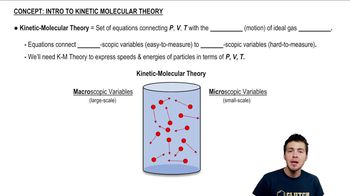
Introduction to Kinetic-Molecular Theory
Molar Mass
Molar mass is the mass of one mole of a substance, typically expressed in grams per mole (g/mol). For CO2, the molar mass is 44.0 g/mol, which is crucial for determining the molecular speed. It allows us to convert between the mass of individual molecules and the macroscopic mass of the gas sample, facilitating calculations involving molecular speeds.
Recommended video:
Guided course
Mass Spectrometers
Maxwell-Boltzmann Distribution
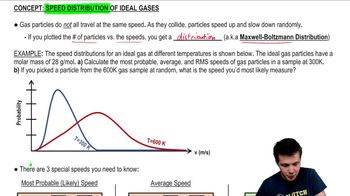
The Maxwell-Boltzmann distribution describes the distribution of speeds among molecules in a gas. It provides a statistical means to calculate the average speed of molecules at a given temperature. The average speed can be derived from this distribution, which is essential for understanding how temperature affects molecular motion in gases like CO2.
Recommended video:
Guided course
Speed Distribution & Special Speeds of Ideal Gases
Related Practice
Textbook Question
2
views
Textbook Question
How much heat does it take to increase the temperature of mol of an ideal gas by K near room temperature if the gas is held at constant volume and is monatomic?
1
views
Textbook Question
For diatomic carbon dioxide gas (CO2, molar mass g/mol) at K, calculate the most probable speed .
1
views
Textbook Question
Compute the specific heat at constant volume of nitrogen (N2) gas, and compare it with the specific heat of liquid water. The molar mass of N2 is g/mol.
1
views
Textbook Question
For a gas of nitrogen molecules (N2), what must the temperature be if of all the molecules have speeds less than m/s? Use Table . The molar mass of N2 is g/mol.
2
views
Textbook Question
For diatomic carbon dioxide gas (CO2, molar mass g/mol) at K, calculate the root-mean-square speed .
1
views
