
Ch 21: Electric Charge and Electric Field
Young & Freedman Calc - University Physics 14th Edition
Young & Freedman Calc14th EditionUniversity PhysicsISBN: 9780321973610Not the one you use?Change textbook
Chapter 21, Problem 53b

Point charges q1=4.5q_1=-4.5 nC and q2=+4.5q_2=+4.5 nC are separated by 3.13.1 mm, forming an electric dipole. The charges are in a uniform electric field whose direction makes an angle of 36.936.9° with the line connecting the charges. What is the magnitude of this field if the torque exerted on the dipole has magnitude 7.2×1097.2\(\times\)10^{-9} Nm?

Verified step by step guidance
1
Understand that the torque \( \tau \) on an electric dipole in a uniform electric field \( E \) is given by the formula \( \tau = pE \sin(\theta) \), where \( p \) is the dipole moment and \( \theta \) is the angle between the dipole moment and the electric field.
Calculate the dipole moment \( p \) using the formula \( p = qd \), where \( q \) is the magnitude of one of the charges and \( d \) is the separation distance between the charges. Here, \( q = 4.5 \times 10^{-9} \) C and \( d = 3.1 \times 10^{-3} \) m.
Substitute the known values into the dipole moment formula: \( p = (4.5 \times 10^{-9} \text{ C})(3.1 \times 10^{-3} \text{ m}) \).
Rearrange the torque formula to solve for the electric field \( E \): \( E = \frac{\tau}{p \sin(\theta)} \).
Substitute the known values into the rearranged formula: \( E = \frac{7.2 \times 10^{-9} \text{ N}\cdot\text{m}}{p \sin(36.9^\circ)} \), using the previously calculated dipole moment \( p \) and the angle \( \theta = 36.9^\circ \).

Verified video answer for a similar problem:

This video solution was recommended by our tutors as helpful for the problem above.
Video duration:
3m
Was this helpful?

Key Concepts

Here are the essential concepts you must grasp in order to answer the question correctly.

Electric Dipole

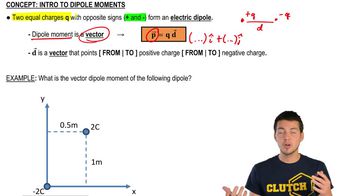
An electric dipole consists of two equal and opposite point charges separated by a distance. It is characterized by its dipole moment, which is the product of the charge magnitude and the separation distance. Dipoles interact with electric fields, experiencing forces and torques depending on the field's orientation relative to the dipole.
Recommended video:
Guided course
03:08
Intro To Dipole Moment

Torque on a Dipole

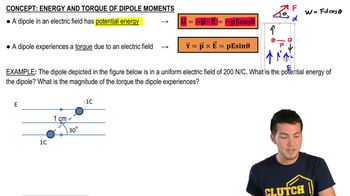
Torque on an electric dipole in a uniform electric field is given by the cross product of the dipole moment and the electric field vector. The magnitude of the torque is calculated as τ = pE sin(θ), where p is the dipole moment, E is the electric field strength, and θ is the angle between the dipole moment and the field direction.
Recommended video:
Guided course
05:19
Energy & Torque of Dipole Moments

Uniform Electric Field

A uniform electric field has constant magnitude and direction throughout a region. In such a field, the force on a charge is constant, and the torque on a dipole depends on the angle between the dipole moment and the field. Understanding how dipoles behave in uniform fields is crucial for calculating forces and torques in electrostatic problems.
Recommended video:
Guided course
03:16
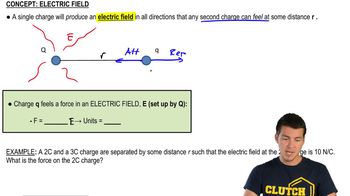
Intro to Electric Fields
Related Practice
Textbook Question

An electric dipole with dipole moment p p is in a uniform external electric field EE. Show that for the stable orientation in part (b), the dipole's own electric field tends to oppose the external field. Note: Part (b) asked which of the orientations in part (a) is stable, and which is unstable? (Hint: Consider a small rotation away from the equilibrium position and see what happens.) Also, part (a) asked to find the orientations of the dipole for which the torque on the dipole is zero.

1
views
Textbook Question

A point charge q1=4.00q_1=-4.00 nC is at the point x=0.600x = 0.600 m, y=0.800y = 0.800 m, and a second point charge q2=+6.00q_2=+6.00 nC is at the point x=0.600x = 0.600 m, y=0y = 0. Calculate the magnitude and direction of the net electric field at the origin due to these two point charges.

Textbook Question

An electric dipole with dipole moment p p is in a uniform external electric field EE. Find the orientations of the dipole for which the torque on the dipole is zero.

1
views
Textbook Question

An electric dipole with dipole moment p p is in a uniform external electric field EE. Which of the orientations in part (a) is stable, and which is unstable? (Hint: Consider a small rotation away from the equilibrium position and see what happens.) Note: Part (a) asked to find the orientations of the dipole for which the torque on the dipole is zero.

2
views
Textbook Question

A very long, straight wire has charge per unit length 3.20×10103.20\(\times\)10^{-10} C/m. At what distance from the wire is the electric field magnitude equal to 2.502.50 N/C?

Textbook Question

A charge of 6.50-6.50 nC is spread uniformly over the surface of one face of a nonconducting disk of radius 1.251.25 cm. Why is the field in part (a) stronger than the field in part (b)? Why is the field in part (c) the strongest of the three fields? Note: Part (a) asked to find the magnitude and direction of the electric field this disk produces at a point PP on the axis of the disk a distance of 2.002.00 cm from its center. Part (b) asked to find the magnitude and direction of the electric field at point PP, supposing that the charge were all pushed away from the center and distributed uniformly on the outer rim of the disk. Part (c) asked to find the magnitude and direction of the electric field at point PP if the charge is all brought to the center of the disk.