
Textbook Question
A point charge nC is at the point m, m, and a second point charge nC is at the point m, . Calculate the magnitude and direction of the net electric field at the origin due to these two point charges.
 Verified step by step guidance

 8:13
8:13
 08:20
08:20 5:05
5:05A point charge nC is at the point m, m, and a second point charge nC is at the point m, . Calculate the magnitude and direction of the net electric field at the origin due to these two point charges.
A point charge is placed at each corner of a square with side length . All charges have magnitude . Two of the charges are positive and two are negative (Fig. E). What is the direction of the net electric field at the center of the square due to the four charges, and what is its magnitude in terms of and ?
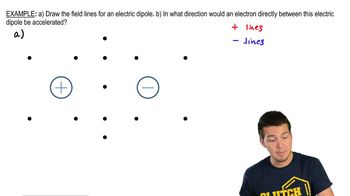
Point charges nC and nC are separated by mm, forming an electric dipole. The charges are in a uniform electric field whose direction makes an angle of ° with the line connecting the charges. What is the magnitude of this field if the torque exerted on the dipole has magnitude Nm?
An electric dipole with dipole moment is in a uniform external electric field . Find the orientations of the dipole for which the torque on the dipole is zero.
An electric dipole with dipole moment is in a uniform external electric field . Which of the orientations in part (a) is stable, and which is unstable? (Hint: Consider a small rotation away from the equilibrium position and see what happens.) Note: Part (a) asked to find the orientations of the dipole for which the torque on the dipole is zero.
A charge of nC is spread uniformly over the surface of one face of a nonconducting disk of radius cm. Why is the field in part (a) stronger than the field in part (b)? Why is the field in part (c) the strongest of the three fields? Note: Part (a) asked to find the magnitude and direction of the electric field this disk produces at a point on the axis of the disk a distance of cm from its center. Part (b) asked to find the magnitude and direction of the electric field at point , supposing that the charge were all pushed away from the center and distributed uniformly on the outer rim of the disk. Part (c) asked to find the magnitude and direction of the electric field at point if the charge is all brought to the center of the disk.