Ch 21: Electric Charge and Electric Field
Young & Freedman Calc - University Physics 14th Edition
Young & Freedman Calc14th EditionUniversity PhysicsISBN: 9780321973610Not the one you use?Change textbook
Chapter 21, Problem 49d

A charge of 6.50-6.50 nC is spread uniformly over the surface of one face of a nonconducting disk of radius 1.251.25 cm. Why is the field in part (a) stronger than the field in part (b)? Why is the field in part (c) the strongest of the three fields? Note: Part (a) asked to find the magnitude and direction of the electric field this disk produces at a point PP on the axis of the disk a distance of 2.002.00 cm from its center. Part (b) asked to find the magnitude and direction of the electric field at point PP, supposing that the charge were all pushed away from the center and distributed uniformly on the outer rim of the disk. Part (c) asked to find the magnitude and direction of the electric field at point PP if the charge is all brought to the center of the disk.

Verified step by step guidance
1
To understand why the electric field strength varies in different parts, we need to consider the distribution of charge and the geometry of the disk. The charge is spread uniformly over the surface of one face of the disk, which affects how the electric field is distributed.
In part (a), the field is stronger than in part (b) because the observation point is closer to the charged surface. The electric field strength decreases with distance from the charge distribution due to the inverse square law, which states that the field strength is inversely proportional to the square of the distance from the charge.
In part (b), the field is weaker because the observation point is further away from the charged surface compared to part (a). The further you are from the charge, the weaker the electric field becomes, as the field lines spread out over a larger area.
In part (c), the field is the strongest because the observation point is directly above the center of the disk, where the charge density is highest. The symmetry of the disk means that the field lines are concentrated and directed perpendicular to the surface, resulting in a stronger field.
The concept of electric field strength can be further understood by considering Gauss's Law, which relates the electric field to the charge enclosed by a surface. The more charge enclosed, or the closer you are to the charge, the stronger the electric field will be.

Verified video answer for a similar problem:

This video solution was recommended by our tutors as helpful for the problem above.
Video duration:
12m
Was this helpful?

Key Concepts

Here are the essential concepts you must grasp in order to answer the question correctly.

Electric Field

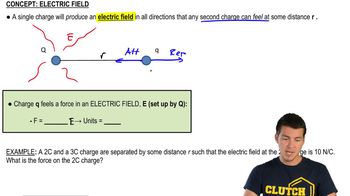
The electric field is a vector field around a charged object where a force would be exerted on other charges. It is defined as the force per unit charge and is measured in newtons per coulomb (N/C). The strength of the electric field depends on the amount of charge and the distance from the charge.
Recommended video:
Guided course
03:16
Intro to Electric Fields

Gauss's Law

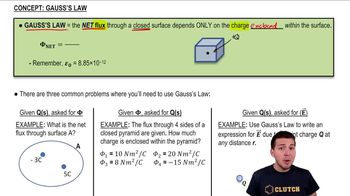
Gauss's Law relates the electric flux through a closed surface to the charge enclosed by that surface. It is a powerful tool for calculating electric fields when the charge distribution has symmetry, such as spherical, cylindrical, or planar symmetry. The law is expressed as Φ = Q_enc/ε₀, where Φ is the electric flux, Q_enc is the enclosed charge, and ε₀ is the permittivity of free space.
Recommended video:

Surface Charge Density

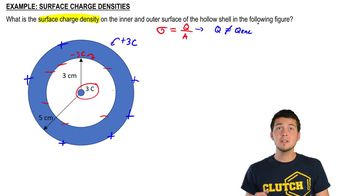
Surface charge density (σ) is the amount of charge per unit area on a surface. It is crucial in determining the electric field produced by a charged surface. For a uniformly charged disk, the surface charge density is calculated by dividing the total charge by the area of the disk. A higher surface charge density results in a stronger electric field near the surface.
Recommended video:
Guided course
04:03
Surface Charge Density
Related Practice
Textbook Question

A point charge q1=4.00q_1=-4.00 nC is at the point x=0.600x = 0.600 m, y=0.800y = 0.800 m, and a second point charge q2=+6.00q_2=+6.00 nC is at the point x=0.600x = 0.600 m, y=0y = 0. Calculate the magnitude and direction of the net electric field at the origin due to these two point charges.

Textbook Question

A point charge is placed at each corner of a square with side length aa. All charges have magnitude qq. Two of the charges are positive and two are negative (Fig. E21.4221.42). What is the direction of the net electric field at the center of the square due to the four charges, and what is its magnitude in terms of qq and aa?

Textbook Question

Point charges q1=4.5q_1=-4.5 nC and q2=+4.5q_2=+4.5 nC are separated by 3.13.1 mm, forming an electric dipole. The charges are in a uniform electric field whose direction makes an angle of 36.936.9° with the line connecting the charges. What is the magnitude of this field if the torque exerted on the dipole has magnitude 7.2×1097.2\(\times\)10^{-9} Nm?

1
views
Textbook Question

An electric dipole with dipole moment p p is in a uniform external electric field EE. Find the orientations of the dipole for which the torque on the dipole is zero.

1
views
Textbook Question

A very long, straight wire has charge per unit length 3.20×10103.20\(\times\)10^{-10} C/m. At what distance from the wire is the electric field magnitude equal to 2.502.50 N/C?

Textbook Question

A 4.00-4.00-nC point charge is at the origin, and a second 5.00-5.00-nC point charge is on the xx-axis at x=0.800x = 0.800 m. Find the net electric force that the two charges would exert on an electron placed at each point in part (a). Note: Part (a) asked to find the electric field (magnitude and direction) at each of the following points on the xx-axis: (i) x=0.200x = 0.200 m; (ii) x=1.20x = 1.20 m; (iii) x=0.200x = -0.200 m.

1
views