
A point charge is placed at each corner of a square with side length . All charges have magnitude . Two of the charges are positive and two are negative (Fig. E). What is the direction of the net electric field at the center of the square due to the four charges, and what is its magnitude in terms of and ?
A point charge nC is at the point m, m, and a second point charge nC is at the point m, . Calculate the magnitude and direction of the net electric field at the origin due to these two point charges.
Verified step by step guidance
Verified video answer for a similar problem:
Key Concepts
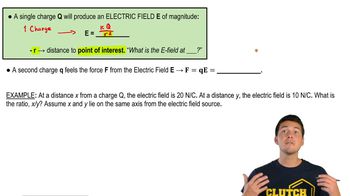
Electric Field Due to a Point Charge
Superposition Principle
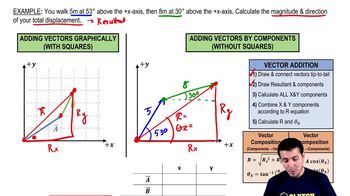
Vector Addition
Point charges nC and nC are separated by mm, forming an electric dipole. The charges are in a uniform electric field whose direction makes an angle of ° with the line connecting the charges. What is the magnitude of this field if the torque exerted on the dipole has magnitude Nm?
A -nC point charge is at the origin, and a second -nC point charge is on the -axis at m. Find the electric field (magnitude and direction) at each of the following points on the -axis: (i) m; (ii) m; (iii) m.
A very long, straight wire has charge per unit length C/m. At what distance from the wire is the electric field magnitude equal to N/C?
A charge of nC is spread uniformly over the surface of one face of a nonconducting disk of radius cm. Why is the field in part (a) stronger than the field in part (b)? Why is the field in part (c) the strongest of the three fields? Note: Part (a) asked to find the magnitude and direction of the electric field this disk produces at a point on the axis of the disk a distance of cm from its center. Part (b) asked to find the magnitude and direction of the electric field at point , supposing that the charge were all pushed away from the center and distributed uniformly on the outer rim of the disk. Part (c) asked to find the magnitude and direction of the electric field at point if the charge is all brought to the center of the disk.
A -nC point charge is at the origin, and a second -nC point charge is on the -axis at m. Find the net electric force that the two charges would exert on an electron placed at each point in part (a). Note: Part (a) asked to find the electric field (magnitude and direction) at each of the following points on the -axis: (i) m; (ii) m; (iii) m.
