
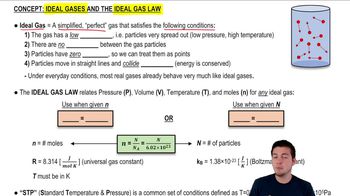
A large cylindrical tank contains m3 of nitrogen gas at °C and Pa (absolute pressure). The tank has a tight-fitting piston that allows the volume to be changed. What will be the pressure if the volume is decreased to m3 and the temperature is increased to °C?
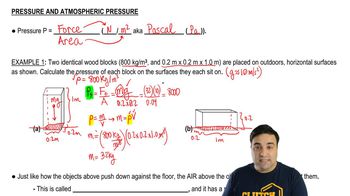
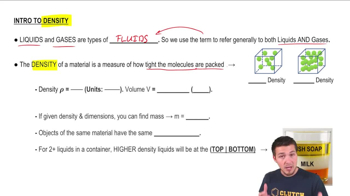
At an altitude of m (a typical cruising altitude for a jet airliner), the air temperature is °C and the air density is kg/m3 . What is the pressure of the atmosphere at that altitude? (Note: The temperature at this altitude is not the same as at the surface of the earth, so the calculation of Example in Section doesn't apply.)
Verified step by step guidance
Verified video answer for a similar problem:
Key Concepts
Ideal Gas Law
Atmospheric Pressure
Density and Temperature Relationship
Modern vacuum pumps make it easy to attain pressures of the order of atm in the laboratory. Consider a volume of air and treat the air as an ideal gas. At a pressure of atm and an ordinary temperature of K, how many molecules are present in a volume of cm3?
Martian Climate. The atmosphere of Mars is mostly CO2 (molar mass 44.0 g/mol) under a pressure of 650 Pa, which we shall assume remains constant. In many places the temperature varies from 0.0°C in summer to -100°C in winter. Over the course of a Martian year, what are the ranges of (b) the density (in mol/m^3) of the atmosphere?
A large organic molecule has a mass of kg. What is the molar mass of this compound?
How many moles are in a -kg bottle of water? How many molecules? The molar mass of water is g/mol.
If a certain amount of ideal gas occupies a volume V at STP on earth, what would be its volume (in terms of V) on Venus, where the temperature is °C and the pressure is atm?
