
Ch 18: Thermal Properties of Matter
Young & Freedman Calc - University Physics 14th Edition
Young & Freedman Calc14th EditionUniversity PhysicsISBN: 9780321973610Not the one you use?Change textbook
Chapter 18, Problem 9

A large cylindrical tank contains 0.7500.750 m3 of nitrogen gas at 2727°C and 7.50×1037.50\(\times\)10^3 Pa (absolute pressure). The tank has a tight-fitting piston that allows the volume to be changed. What will be the pressure if the volume is decreased to 0.4100.410 m3 and the temperature is increased to 157157°C?

Verified step by step guidance
1
Start by identifying the initial and final states of the gas. The initial state has a volume \( V_1 = 0.750 \, \text{m}^3 \), temperature \( T_1 = 27^\circ \text{C} \), and pressure \( P_1 = 7.50 \times 10^3 \, \text{Pa} \). The final state has a volume \( V_2 = 0.410 \, \text{m}^3 \) and temperature \( T_2 = 157^\circ \text{C} \).
Convert the temperatures from Celsius to Kelvin, as the ideal gas law requires temperatures in Kelvin. Use the formula \( T(K) = T(^\circ C) + 273.15 \). Thus, \( T_1 = 27 + 273.15 = 300.15 \, \text{K} \) and \( T_2 = 157 + 273.15 = 430.15 \, \text{K} \).
Apply the combined gas law, which relates the pressure, volume, and temperature of a gas: \( \frac{P_1 V_1}{T_1} = \frac{P_2 V_2}{T_2} \). This equation assumes the amount of gas remains constant.
Rearrange the combined gas law to solve for the final pressure \( P_2 \): \( P_2 = P_1 \times \frac{V_1}{V_2} \times \frac{T_2}{T_1} \).
Substitute the known values into the equation: \( P_2 = 7.50 \times 10^3 \, \text{Pa} \times \frac{0.750 \, \text{m}^3}{0.410 \, \text{m}^3} \times \frac{430.15 \, \text{K}}{300.15 \, \text{K}} \). Calculate \( P_2 \) using these values to find the final pressure.

Verified video answer for a similar problem:

This video solution was recommended by our tutors as helpful for the problem above.
Video duration:
8m
Was this helpful?

Key Concepts

Here are the essential concepts you must grasp in order to answer the question correctly.

Ideal Gas Law

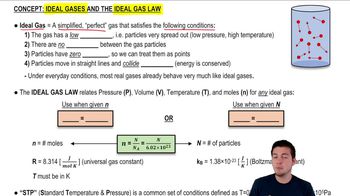
The Ideal Gas Law is a fundamental equation in physics that relates the pressure, volume, and temperature of an ideal gas. It is expressed as PV = nRT, where P is pressure, V is volume, T is temperature, n is the number of moles, and R is the ideal gas constant. This law helps predict how a gas will respond to changes in pressure, volume, and temperature.
Recommended video:
Guided course
07:21
Ideal Gases and the Ideal Gas Law

Charles's Law

Charles's Law states that the volume of a gas is directly proportional to its temperature when pressure is held constant. This means that if the temperature of a gas increases, its volume increases, provided the pressure remains unchanged. This concept is crucial when analyzing how temperature changes affect gas volume in a closed system.
Recommended video:

Boyle's Law

Boyle's Law describes the inverse relationship between the pressure and volume of a gas at constant temperature. According to this law, if the volume of a gas decreases, its pressure increases, assuming the temperature remains constant. This principle is essential for understanding how volume reduction impacts gas pressure in a confined space.
Recommended video:
Related Practice
Textbook Question

At an altitude of 11,00011,000 m (a typical cruising altitude for a jet airliner), the air temperature is 56.5-56.5°C and the air density is 0.3640.364 kg/m3 . What is the pressure of the atmosphere at that altitude? (Note: The temperature at this altitude is not the same as at the surface of the earth, so the calculation of Example 18.418.4 in Section 18.118.1 doesn't apply.)

2
views
Textbook Question

Martian Climate. The atmosphere of Mars is mostly CO2 (molar mass 44.0 g/mol) under a pressure of 650 Pa, which we shall assume remains constant. In many places the temperature varies from 0.0°C in summer to -100°C in winter. Over the course of a Martian year, what are the ranges of (b) the density (in mol/m^3) of the atmosphere?

2
views
Textbook Question

Calculate the density of the atmosphere at the surface of Mars (where the pressure is 650650 Pa and the temperature is typically 253253 K, with a CO2 atmosphere), Venus (with an average temperature of 730730 K and pressure of 9292 atm, with a CO2 atmosphere), and Saturn's moon Titan (where the pressure is 1.51.5 atm and the temperature is 178-178°C, with a N2 atmosphere).

2
views
Textbook Question

A cylindrical tank has a tight-fitting piston that allows the volume of the tank to be changed. The tank originally contains 0.1100.110 m3 of air at a pressure of 0.3550.355 atm. The piston is slowly pulled out until the volume of the gas is increased to 0.3900.390 m3. If the temperature remains constant, what is the final value of the pressure?

3
views
Textbook Question

If a certain amount of ideal gas occupies a volume V at STP on earth, what would be its volume (in terms of V) on Venus, where the temperature is 10031003°C and the pressure is 9292 atm?

2
views
Textbook Question

You have several identical balloons. You experimentally determine that a balloon will break if its volume exceeds 0.9000.900 L. The pressure of the gas inside the balloon equals air pressure (1.001.00 atm). If the air inside the balloon is at a constant 22.022.0°C and behaves as an ideal gas, what mass of air can you blow into one of the balloons before it bursts?

1
views