
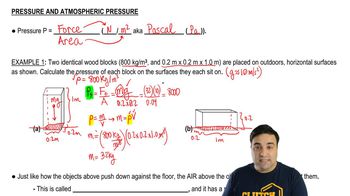
At an altitude of m (a typical cruising altitude for a jet airliner), the air temperature is °C and the air density is kg/m3 . What is the pressure of the atmosphere at that altitude? (Note: The temperature at this altitude is not the same as at the surface of the earth, so the calculation of Example in Section doesn't apply.)
If a certain amount of ideal gas occupies a volume V at STP on earth, what would be its volume (in terms of V) on Venus, where the temperature is °C and the pressure is atm?
Verified step by step guidance
Verified video answer for a similar problem:
Key Concepts
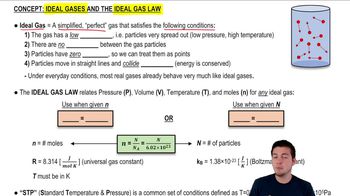
Ideal Gas Law
Standard Temperature and Pressure (STP)
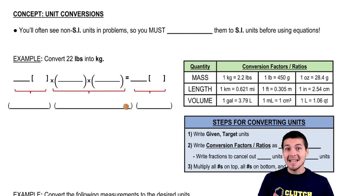
Temperature Conversion
A large cylindrical tank contains m3 of nitrogen gas at °C and Pa (absolute pressure). The tank has a tight-fitting piston that allows the volume to be changed. What will be the pressure if the volume is decreased to m3 and the temperature is increased to °C?
Martian Climate. The atmosphere of Mars is mostly CO2 (molar mass 44.0 g/mol) under a pressure of 650 Pa, which we shall assume remains constant. In many places the temperature varies from 0.0°C in summer to -100°C in winter. Over the course of a Martian year, what are the ranges of (b) the density (in mol/m^3) of the atmosphere?
Calculate the density of the atmosphere at the surface of Mars (where the pressure is Pa and the temperature is typically K, with a CO2 atmosphere), Venus (with an average temperature of K and pressure of atm, with a CO2 atmosphere), and Saturn's moon Titan (where the pressure is atm and the temperature is °C, with a N2 atmosphere).
How many moles are in a -kg bottle of water? How many molecules? The molar mass of water is g/mol.
You have several identical balloons. You experimentally determine that a balloon will break if its volume exceeds L. The pressure of the gas inside the balloon equals air pressure ( atm). If the air inside the balloon is at a constant °C and behaves as an ideal gas, what mass of air can you blow into one of the balloons before it bursts?
