
Ch 18: Thermal Properties of Matter
Young & Freedman Calc - University Physics 14th Edition
Young & Freedman Calc14th EditionUniversity PhysicsISBN: 9780321973610Not the one you use?Change textbook
Chapter 18, Problem 22

A large organic molecule has a mass of 1.41×10211.41\(\times\)10^{-21} kg. What is the molar mass of this compound?

Verified step by step guidance
1
Understand that molar mass is the mass of one mole of a substance, typically expressed in grams per mole (g/mol). To find the molar mass, we need to relate the mass of a single molecule to the mass of one mole of molecules.
Recall that one mole of any substance contains Avogadro's number of molecules, which is approximately 6.022 x 10^23 molecules/mol.
To find the molar mass, multiply the mass of a single molecule by Avogadro's number. This will give you the mass of one mole of molecules.
Set up the equation for molar mass: Molar Mass = (mass of one molecule) * (Avogadro's number).
Substitute the given mass of the molecule (1.41 * 10^-21 kg) and Avogadro's number (6.022 x 10^23 molecules/mol) into the equation to find the molar mass in kg/mol. Convert this result to g/mol by multiplying by 1000, since 1 kg = 1000 g.

Verified video answer for a similar problem:

This video solution was recommended by our tutors as helpful for the problem above.
Video duration:
1m
Was this helpful?

Key Concepts

Here are the essential concepts you must grasp in order to answer the question correctly.

Molar Mass

Molar mass is the mass of one mole of a substance, typically expressed in grams per mole (g/mol). It is calculated by summing the atomic masses of all atoms in a molecule. Understanding molar mass is crucial for converting between the mass of a substance and the amount in moles, which is essential for stoichiometric calculations in chemistry.
Recommended video:
Guided course
20:32
Mass Spectrometers

Avogadro's Number

Avogadro's number, approximately 6.022 x 10^23, is the number of atoms, ions, or molecules in one mole of a substance. This constant allows chemists to relate the macroscopic scale of substances we can measure to the microscopic scale of individual molecules or atoms, facilitating the calculation of molar mass from the mass of a single molecule.
Recommended video:
Guided course
07:19
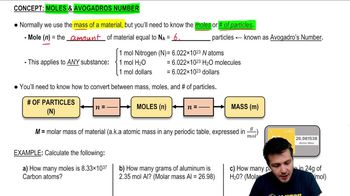
Moles & Avogadro's Number

Conversion from Molecular Mass to Molar Mass

To find the molar mass from the mass of a single molecule, multiply the molecular mass by Avogadro's number. This conversion is based on the definition of a mole, which links the mass of individual molecules to the mass of a mole of those molecules, providing a bridge between atomic-scale measurements and laboratory-scale quantities.
Recommended video:
Guided course
20:32
Mass Spectrometers
Related Practice
Textbook Question

At an altitude of 11,00011,000 m (a typical cruising altitude for a jet airliner), the air temperature is 56.5-56.5°C and the air density is 0.3640.364 kg/m3 . What is the pressure of the atmosphere at that altitude? (Note: The temperature at this altitude is not the same as at the surface of the earth, so the calculation of Example 18.418.4 in Section 18.118.1 doesn't apply.)

2
views
Textbook Question

Modern vacuum pumps make it easy to attain pressures of the order of 101310^{-13} atm in the laboratory. Consider a volume of air and treat the air as an ideal gas. At a pressure of 9.00×10149.00\(\times\)10^{-14} atm and an ordinary temperature of 300.0300.0 K, how many molecules are present in a volume of 1.001.00 cm3?

3
views
Textbook Question

Martian Climate. The atmosphere of Mars is mostly CO2 (molar mass 44.0 g/mol) under a pressure of 650 Pa, which we shall assume remains constant. In many places the temperature varies from 0.0°C in summer to -100°C in winter. Over the course of a Martian year, what are the ranges of (b) the density (in mol/m^3) of the atmosphere?

2
views
Textbook Question

How many moles are in a 1.001.00-kg bottle of water? How many molecules? The molar mass of water is 18.018.0 g/mol.

2
views
Textbook Question

Modern vacuum pumps make it easy to attain pressures of the order of 101310^{-13} atm in the laboratory. Consider a volume of air and treat the air as an ideal gas. How many molecules would be present at the same temperature but at 1.001.00 atm instead?

2
views
Textbook Question

In a gas at standard conditions, what is the length of the side of a cube that contains a number of molecules equal to the population of the earth (about 7×1097\(\times\)10^9 people)?