Ch 36: Special Relativity
Knight Calc - Physics for Scientists and Engineers 5th Edition
Knight Calc5th EditionPhysics for Scientists and EngineersISBN: 9780137344796Not the one you use?Change textbook
Chapter 36, Problem 19b

You fly 5000 km across the United States on an airliner at 250 m/s. You return two days later at the same speed. By how much? Hint: Use the binomial approximation.

Verified step by step guidance
1
Understand the problem: This is a relativistic time dilation problem. The goal is to calculate the time difference (Δt) experienced by the passengers on the airliner compared to someone stationary on the ground. The binomial approximation will simplify the relativistic factor for small velocities compared to the speed of light.
Write the time dilation formula: Δt' = Δt / √(1 - v²/c²), where Δt' is the proper time experienced by the stationary observer, Δt is the time experienced by the moving observer, v is the velocity of the airliner, and c is the speed of light (approximately 3 × 10⁸ m/s).
Apply the binomial approximation: For v²/c² << 1, √(1 - v²/c²) ≈ 1 - (1/2)(v²/c²). Substituting this into the time dilation formula gives Δt' ≈ Δt × (1 + (1/2)(v²/c²)).
Calculate the total time experienced by the passengers: First, determine the total flight time for one trip using t = d/v, where d = 5000 km = 5 × 10⁶ m and v = 250 m/s. Then double this time for the round trip. Use this value as Δt in the formula.
Determine the time difference: Subtract the proper time (Δt) from the dilated time (Δt') to find the time difference experienced by the passengers compared to the stationary observer. This will give the relativistic time difference due to the airliner's motion.

Verified video answer for a similar problem:

This video solution was recommended by our tutors as helpful for the problem above.
Was this helpful?

Key Concepts

Here are the essential concepts you must grasp in order to answer the question correctly.

Speed and Distance

Speed is defined as the distance traveled per unit of time. In this scenario, the airliner travels 5000 km at a speed of 250 m/s. Understanding the relationship between speed, distance, and time is crucial for calculating travel duration and any related effects, such as time dilation in relativistic contexts.
Recommended video:
Guided course
06:24
Satellite Speed

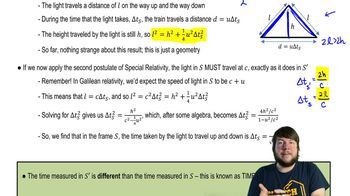
Time Dilation

Time dilation is a concept from Einstein's theory of relativity, which states that time passes at different rates for observers in different frames of reference, particularly at high speeds. In this problem, the speed of the airliner is significant enough that time dilation effects may need to be considered, especially when using the binomial approximation to simplify calculations.
Recommended video:
Guided course
12:57
Time Dilation

Binomial Approximation

The binomial approximation is a mathematical technique used to simplify expressions involving powers of binomials, particularly when one term is much smaller than the other. In the context of this problem, it can be applied to approximate the effects of time dilation without complex calculations, making it easier to understand how the travel time is affected by the speed of the airliner.
Recommended video:
Guided course
03:46
Index of Refraction