
Ch 36: Special Relativity
Knight Calc - Physics for Scientists and Engineers 5th Edition
Knight Calc5th EditionPhysics for Scientists and EngineersISBN: 9780137344796Not the one you use?Change textbook
Chapter 36, Problem 24b

Our Milky Way galaxy is 100,000 ly in diameter. A spaceship crossing the galaxy measures the galaxy’s diameter to be a mere 1.0 ly. How long is the crossing time as measured in the galaxy’s reference frame?

Verified step by step guidance
1
Step 1: Recognize that this problem involves relativistic effects, specifically length contraction and time dilation, as described by Einstein's theory of special relativity.
Step 2: Use the length contraction formula to relate the proper length (L₀, the galaxy's diameter in its own reference frame) to the contracted length (L, the diameter measured by the spaceship): L=L0(1-v2c2). Here, v is the spaceship's velocity and c is the speed of light.
Step 3: Rearrange the formula to solve for the spaceship's velocity (v) using the given values: L₀ = 100,000 ly and L = 1.0 ly. Substitute these values into the equation and isolate v.
Step 4: Once the velocity (v) is determined, use the time dilation formula to calculate the crossing time as measured in the galaxy’s reference frame: tgalaxy=Lv. Here, t_galaxy is the crossing time in the galaxy's frame, L₀ is the proper length, and v is the velocity of the spaceship.
Step 5: Substitute the values of L₀ and v into the formula to find the crossing time in the galaxy’s reference frame. Ensure all units are consistent (e.g., light-years for distance and years for time).

Verified video answer for a similar problem:

This video solution was recommended by our tutors as helpful for the problem above.
Was this helpful?

Key Concepts

Here are the essential concepts you must grasp in order to answer the question correctly.

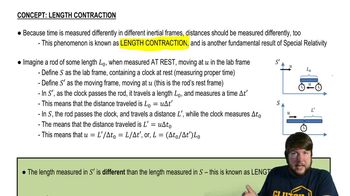
Length Contraction

Length contraction is a phenomenon predicted by Einstein's theory of special relativity, where an object in motion is measured to be shorter along the direction of motion relative to a stationary observer. This effect becomes significant at speeds approaching the speed of light, leading to discrepancies in measurements of distance, such as the spaceship measuring the Milky Way's diameter as 1.0 light-year instead of 100,000 light-years.
Recommended video:
Guided course
07:02
Length Contraction

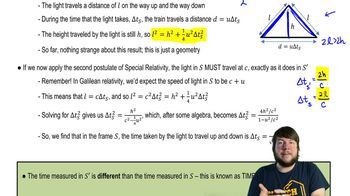
Time Dilation

Time dilation is another consequence of special relativity, where time is observed to pass at different rates for observers in different frames of reference, particularly when one is moving at a significant fraction of the speed of light. For the spaceship traveling through the galaxy, the time experienced by the crew will differ from the time measured in the galaxy's reference frame, affecting the perceived crossing time.
Recommended video:
Guided course
12:57
Time Dilation

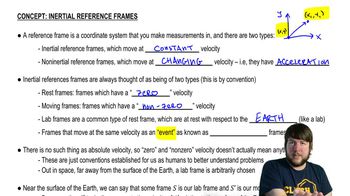
Reference Frames

A reference frame is a perspective from which measurements of space and time are made. In this scenario, the galaxy's reference frame is stationary relative to the Milky Way, while the spaceship's frame is moving. Understanding how to switch between these frames is crucial for calculating the crossing time, as it involves applying the principles of relativity to relate the measurements taken in each frame.
Recommended video:
Guided course
14:10
Inertial Reference Frames