
Ch 36: Special Relativity
Knight Calc - Physics for Scientists and Engineers 5th Edition
Knight Calc5th EditionPhysics for Scientists and EngineersISBN: 9780137344796Not the one you use?Change textbook
Chapter 36, Problem 29

A distant quasar is found to be moving away from the earth at 0.80c. A galaxy closer to the earth and along the same line of sight is moving away from us at 0.20c. What is the recessional speed of the quasar, as a fraction of c, as measured by astronomers in the other galaxy?

Verified step by step guidance
1
Step 1: Recognize that the problem involves relativistic velocities. When two objects are moving relative to each other at significant fractions of the speed of light, we cannot simply add their velocities. Instead, we use the relativistic velocity addition formula: \( v_{\text{rel}} = \frac{v_1 + v_2}{1 + \frac{v_1 v_2}{c^2}} \), where \( v_1 \) and \( v_2 \) are the velocities of the two objects relative to a common reference frame, and \( c \) is the speed of light.
Step 2: Assign the given values to the formula. Here, \( v_1 = 0.80c \) (velocity of the quasar relative to Earth) and \( v_2 = 0.20c \) (velocity of the galaxy relative to Earth). Substitute these values into the relativistic velocity addition formula.
Step 3: Simplify the numerator of the formula. The numerator is \( v_1 + v_2 \), which becomes \( 0.80c + 0.20c \). This simplifies to \( 1.00c \).
Step 4: Simplify the denominator of the formula. The denominator is \( 1 + \frac{v_1 v_2}{c^2} \). Substitute \( v_1 = 0.80c \) and \( v_2 = 0.20c \) into \( \frac{v_1 v_2}{c^2} \), which becomes \( \frac{(0.80c)(0.20c)}{c^2} = 0.16 \). Thus, the denominator becomes \( 1 + 0.16 = 1.16 \).
Step 5: Combine the simplified numerator and denominator into the formula. The relativistic velocity \( v_{\text{rel}} \) is \( \frac{1.00c}{1.16} \). This represents the recessional speed of the quasar as measured by astronomers in the galaxy.

Verified video answer for a similar problem:

This video solution was recommended by our tutors as helpful for the problem above.
Was this helpful?

Key Concepts

Here are the essential concepts you must grasp in order to answer the question correctly.

Relativistic Velocity Addition

In the realm of special relativity, velocities do not simply add together as they do in classical mechanics. Instead, the relativistic velocity addition formula must be used, which accounts for the effects of traveling at speeds close to the speed of light (c). This formula ensures that the resultant velocity never exceeds c, maintaining the principles of relativity.
Recommended video:
Guided course
7:27
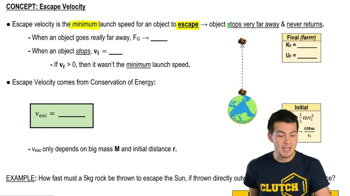
Escape Velocity

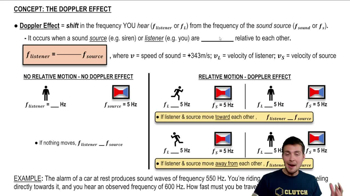
Doppler Effect in Astronomy

The Doppler effect describes how the observed frequency of light or other waves changes due to the relative motion of the source and the observer. In astronomy, this effect is crucial for understanding the recessional speeds of celestial objects, as it allows astronomers to determine how fast an object is moving away from us based on the redshift of its light.
Recommended video:
Guided course
07:40
The Doppler Effect

Reference Frames

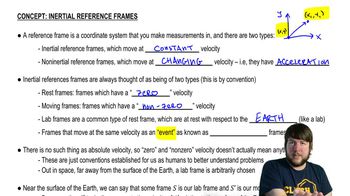
A reference frame is a perspective from which measurements are made, including the observer's state of motion. In this context, the recessional speed of the quasar must be calculated from the perspective of the galaxy moving at 0.20c, which requires transforming the velocities into a common reference frame to accurately assess the relative motion.
Recommended video:
Guided course
14:10
Inertial Reference Frames