
Ch 36: Special Relativity
Knight Calc - Physics for Scientists and Engineers 5th Edition
Knight Calc5th EditionPhysics for Scientists and EngineersISBN: 9780137344796Not the one you use?Change textbook
Chapter 36, Problem 21

Jill claims that her new rocket is 100 m long. As she flies past your house, you measure the rocket’s length and find that it is only 80 m. What is Jill’s speed, as a fraction of c?

Verified step by step guidance
1
Step 1: Recognize that this problem involves the concept of length contraction, which is a phenomenon described by Einstein's theory of special relativity. Length contraction occurs when an object moves at a significant fraction of the speed of light (c) relative to an observer.
Step 2: Use the length contraction formula: L = L₀ √(1 - v²/c²), where L is the contracted length observed (80 m), L₀ is the proper length (100 m), v is the speed of the rocket, and c is the speed of light.
Step 3: Rearrange the formula to solve for the speed v as a fraction of c. Start by dividing both sides of the equation by L₀: L/L₀ = √(1 - v²/c²). Then square both sides to eliminate the square root: (L/L₀)² = 1 - v²/c².
Step 4: Isolate the term v²/c² by subtracting (L/L₀)² from 1: v²/c² = 1 - (L/L₀)². Then take the square root of both sides to solve for v/c: v/c = √[1 - (L/L₀)²].
Step 5: Substitute the given values into the equation. L₀ = 100 m and L = 80 m, so v/c = √[1 - (80/100)²]. Simplify the fraction and calculate the result to find Jill's speed as a fraction of c.

Verified video answer for a similar problem:

This video solution was recommended by our tutors as helpful for the problem above.
Was this helpful?

Key Concepts

Here are the essential concepts you must grasp in order to answer the question correctly.

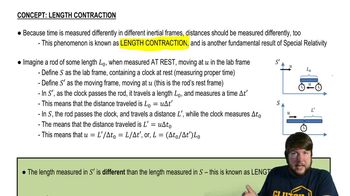
Length Contraction

Length contraction is a phenomenon predicted by Einstein's theory of special relativity, where the length of an object moving at a significant fraction of the speed of light appears shorter to an observer at rest. This effect becomes noticeable as the object's speed approaches the speed of light (c), leading to discrepancies between the proper length (the length measured in the object's rest frame) and the length measured by an observer in motion relative to the object.
Recommended video:
Guided course
07:02
Length Contraction

Relativistic Speed

Relativistic speed refers to speeds that are a significant fraction of the speed of light (c). At these speeds, classical mechanics no longer accurately describes motion, and relativistic effects, such as time dilation and length contraction, must be considered. To calculate an object's speed as a fraction of c, one must use the Lorentz transformation equations, which relate the measurements of time and space between different inertial frames.
Recommended video:
Guided course
07:59
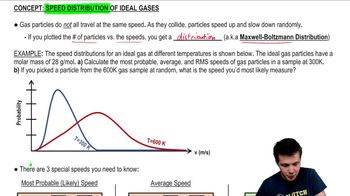
Speed Distribution & Special Speeds of Ideal Gases

Lorentz Factor

The Lorentz factor (γ) is a crucial component in special relativity that quantifies the effects of relativistic speeds on time, length, and relativistic mass. It is defined as γ = 1 / √(1 - v²/c²), where v is the object's speed and c is the speed of light. This factor is used to calculate how much time dilates and lengths contract as an object approaches the speed of light, allowing for the determination of the observed length of moving objects.
Recommended video:
Guided course
14:16
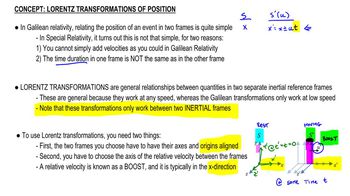
Lorentz Transformations of Position