Ch 36: Special Relativity
Knight Calc - Physics for Scientists and Engineers 5th Edition
Knight Calc5th EditionPhysics for Scientists and EngineersISBN: 9780137344796Not the one you use?Change textbook
Chapter 36, Problem 19a

You fly 5000 km across the United States on an airliner at 250 m/s. You return two days later at the same speed. Have you aged more or less than your friends at home?

Verified step by step guidance
1
Understand the concept: This problem involves time dilation, a phenomenon predicted by Einstein's theory of special relativity. Time dilation occurs when an object moves at a significant fraction of the speed of light, causing time to pass more slowly for the moving object relative to a stationary observer.
Identify the formula for time dilation: The time dilation equation is given by t' = t / sqrt(1 - v^2 / c^2), where t' is the time experienced by the moving observer, t is the time experienced by the stationary observer, v is the velocity of the moving object, and c is the speed of light.
Substitute the given values: The airliner's speed is v = 250 \, \(\text{m/s}\), and the speed of light is c = 3 \(\times\) 10^8 \, \(\text{m/s}\). The total time for the round trip is two days, which is t = 2 \(\times\) 24 \(\times\) 60 \(\times\) 60 \, \(\text{s}\).
Calculate the factor 1 - v^2 / c^2: Compute the ratio of the square of the airliner's speed to the square of the speed of light, v^2 / c^2, and subtract it from 1. This value will be very close to 1 because v is much smaller than c.
Interpret the result: Since the airliner's speed is much smaller than the speed of light, the time dilation effect will be extremely small. You will have aged slightly less than your friends at home, but the difference is negligible and practically unnoticeable.

Verified video answer for a similar problem:

This video solution was recommended by our tutors as helpful for the problem above.
Was this helpful?

Key Concepts

Here are the essential concepts you must grasp in order to answer the question correctly.

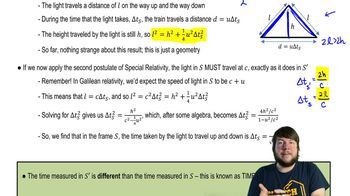
Time Dilation

Time dilation is a concept from Einstein's theory of relativity, which states that time passes at different rates for observers in different frames of reference. Specifically, an object moving at a significant fraction of the speed of light will experience time more slowly compared to a stationary observer. In this scenario, the airliner traveling at 250 m/s will experience a slight time dilation effect relative to friends at home.
Recommended video:
Guided course
12:57
Time Dilation

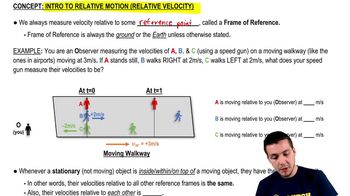
Relativity of Simultaneity

The relativity of simultaneity is another principle of relativity that indicates that events that are simultaneous in one frame of reference may not be simultaneous in another. This means that the perception of time can differ based on the observer's state of motion. In the context of the question, while the traveler is in motion, their experience of time will differ from that of their friends who remain stationary.
Recommended video:
Guided course
04:27
Intro to Relative Motion (Relative Velocity)

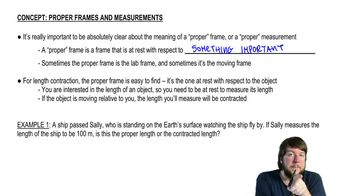
Proper Time

Proper time is the time measured by a clock that is at rest relative to the observer. It is the time interval between two events as measured by an observer who sees both events occur at the same location. In this case, the friends at home measure proper time, while the traveler on the airliner experiences a different elapsed time due to their motion, leading to the conclusion that they will have aged slightly less than their friends.
Recommended video:
Guided course
07:49
Proper Frames and Measurements