Ch 34: Ray Optics
Knight Calc - Physics for Scientists and Engineers 5th Edition
Knight Calc5th EditionPhysics for Scientists and EngineersISBN: 9780137344796Not the one you use?Change textbook
Chapter 34, Problem 59

You're visiting the shark tank at the aquarium when you see a 2.5-m-long shark that appears to be swimming straight toward you at 2.0 m/s. What is the shark's actual speed through the water? You can ignore the glass wall of the tank.

Verified step by step guidance
1
Step 1: Recognize that the problem involves relative motion. The shark's apparent speed (2.0 m/s) is due to the perspective of the observer, but the actual speed of the shark through the water needs to be determined.
Step 2: Identify the key variables. The shark's length is given as 2.5 m, and its apparent speed is 2.0 m/s. The problem does not mention any additional factors like water currents or observer motion, so we assume the shark's actual speed is the same as its apparent speed.
Step 3: Understand that the glass wall of the tank does not affect the shark's speed through the water. The problem explicitly states to ignore the glass wall, meaning it does not distort the observation.
Step 4: Conclude that the shark's actual speed through the water is the same as its apparent speed, since no other factors are influencing the motion. The shark is swimming straight toward the observer at 2.0 m/s.
Step 5: If needed, verify the reasoning by considering the absence of external forces or distortions. The problem is straightforward and does not require additional calculations beyond understanding the context.

Verified video answer for a similar problem:

This video solution was recommended by our tutors as helpful for the problem above.
Was this helpful?

Key Concepts

Here are the essential concepts you must grasp in order to answer the question correctly.

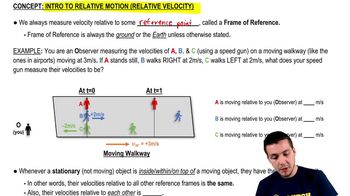
Relative Motion

Relative motion refers to the calculation of the motion of an object as observed from a particular reference frame. In this scenario, the shark's speed is measured relative to the water, not the observer. Understanding relative motion is crucial for determining the actual speed of the shark through the water, as it may differ from the perceived speed due to the observer's own motion or position.
Recommended video:
Guided course
04:27
Intro to Relative Motion (Relative Velocity)

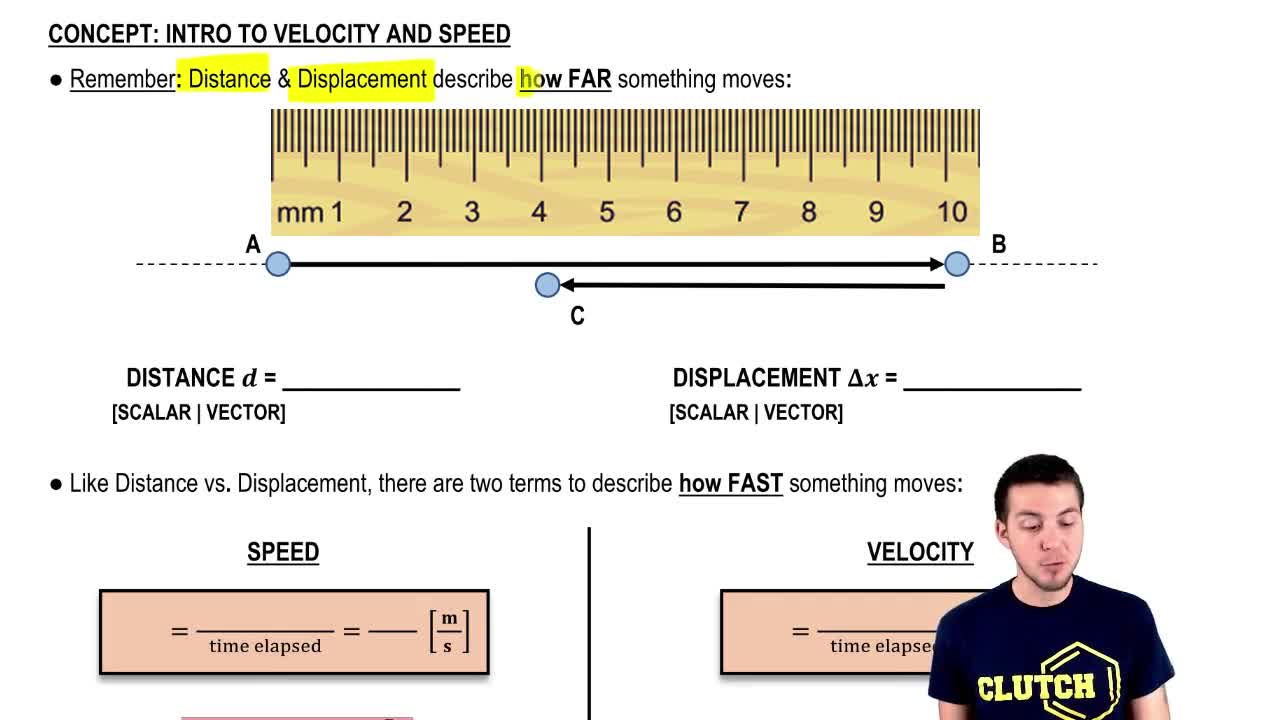
Speed and Velocity

Speed is a scalar quantity that represents how fast an object is moving, while velocity is a vector quantity that includes both speed and direction. In this question, the shark's speed is given as 2.0 m/s, but to find its actual velocity through the water, one must consider the direction of the shark's movement relative to the observer. This distinction is important for accurately interpreting the shark's motion.
Recommended video:
Guided course
05:35
Intro to Velocity and Speed

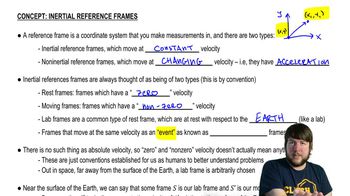
Frame of Reference

A frame of reference is a set of coordinates or a viewpoint used to measure and describe the position and motion of objects. In this case, the observer's frame of reference affects how the shark's speed is perceived. By understanding the frame of reference, one can correctly analyze the shark's speed through the water, ensuring that the calculations account for any relative motion between the observer and the shark.
Recommended video:
Guided course
14:10
Inertial Reference Frames
Related Practice
Textbook Question

BIO A dentist uses a curved mirror to view the back side of teeth in the upper jaw. Suppose she wants an upright image with a magnification of 1.5 when the mirror is 1.2 cm from a tooth. Should she use a convex or a concave mirror? What focal length should it have?

1
views
Textbook Question

There's one angle of incidence β onto a prism for which the light inside an isosceles prism travels parallel to the base and emerges at angle β. A laboratory measurement finds that β=52.2° for a prism shaped like an equilateral triangle. What is the prism's index of refraction?

1
views
Textbook Question

Optical engineers need to know the cone of acceptance of an optical fiber. This is the maximum angle that an entering light ray can make with the axis of the fiber if it is to be guided down the fiber. What is the cone of acceptance of an optical fiber for which the index of refraction of the core is 1.55 while that of the cladding is 1.45? You can model the fiber as a cylinder with a flat entrance face.

1
views
Textbook Question

Paraxial light rays approach a transparent sphere parallel to an optical axis passing through the center of the sphere. The rays come to a focus on the far surface of the sphere. What is the sphere's index of refraction?

1
views
Textbook Question

A horizontal laser beam enters the glass prism shown in FIGURE P34.55. When the laser beam exits the prism, by what angle will it have been deflected from horizontal?

1
views
Textbook Question

BIO A keratometer is an optical device used to measure the radius of curvature of the eye's cornea—its entrance surface. This measurement is especially important when fitting contact lenses, which must match the cornea's curvature. Most light incident on the eye is transmitted into the eye, but some light reflects from the cornea, which, due to its curvature, acts like a convex mirror. The keratometer places a small, illuminated ring of known diameter 7.5 cm in front of the eye. The optometrist, using an eyepiece, looks through the center of this ring and sees a small virtual image of the ring that appears to be behind the cornea. The optometrist uses a scale inside the eyepiece to measure the diameter of the image and calculate its magnification. Suppose the optometrist finds that the magnification for one patient is 0.049. What is the absolute value of the radius of curvature of her cornea?

2
views