
Ch 34: Ray Optics
Knight Calc - Physics for Scientists and Engineers 5th Edition
Knight Calc5th EditionPhysics for Scientists and EngineersISBN: 9780137344796Not the one you use?Change textbook
Chapter 34, Problem 58b

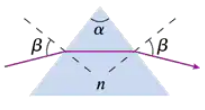
There's one angle of incidence β onto a prism for which the light inside an isosceles prism travels parallel to the base and emerges at angle β. A laboratory measurement finds that β=52.2° for a prism shaped like an equilateral triangle. What is the prism's index of refraction?

Verified step by step guidance
1
Step 1: Identify the geometry of the prism. The prism is an equilateral triangle, meaning all angles inside the prism are 60°. The angle of incidence β is given as 52.2°, and the light travels parallel to the base inside the prism.
Step 2: Use Snell's Law at the first interface where the light enters the prism. Snell's Law is expressed as: n1sinβ=n2sinθ, where n₁ is the refractive index of air (approximately 1), n₂ is the refractive index of the prism, β is the angle of incidence, and θ is the angle of refraction.
Step 3: Recognize that for the light to travel parallel to the base, the angle of refraction θ inside the prism must equal the prism angle α (60°). Substitute θ = 60° into Snell's Law: sinβ=nsinα, where n is the refractive index of the prism.
Step 4: Rearrange Snell's Law to solve for the refractive index n of the prism: n=sinβsinα. Substitute β = 52.2° and α = 60° into the equation.
Step 5: Perform the calculation using the sine values of the angles. This will yield the refractive index n of the prism. Ensure the sine values are calculated accurately using a scientific calculator or trigonometric table.

Verified video answer for a similar problem:

This video solution was recommended by our tutors as helpful for the problem above.
Was this helpful?

Key Concepts

Here are the essential concepts you must grasp in order to answer the question correctly.

Refraction

Refraction is the bending of light as it passes from one medium to another with a different index of refraction. This phenomenon occurs due to the change in the speed of light in different materials, which is described by Snell's Law. The law states that the ratio of the sine of the angle of incidence to the sine of the angle of refraction is constant and equal to the ratio of the indices of refraction of the two media.
Recommended video:
Guided course
03:46
Index of Refraction

Index of Refraction

The index of refraction (n) is a dimensionless number that describes how much light slows down in a medium compared to its speed in a vacuum. It is defined as the ratio of the speed of light in vacuum to the speed of light in the medium. For example, an index of refraction of 1.5 indicates that light travels 1.5 times slower in that medium than in a vacuum, which is crucial for understanding how light behaves in prisms.
Recommended video:
Guided course
03:46
Index of Refraction

Prism Geometry

The geometry of a prism, particularly an isosceles or equilateral prism, plays a significant role in determining how light refracts within it. In the case of an equilateral prism, the angles are all 60 degrees, which influences the relationship between the angles of incidence and refraction. Understanding the angles involved helps in applying Snell's Law to find the index of refraction when light travels parallel to the base of the prism.
Recommended video:
Guided course
04:33
Problems with Mass, Volume, & Density
Related Practice
Textbook Question

BIO A dentist uses a curved mirror to view the back side of teeth in the upper jaw. Suppose she wants an upright image with a magnification of 1.5 when the mirror is 1.2 cm from a tooth. Should she use a convex or a concave mirror? What focal length should it have?

1
views
Textbook Question

Shown from above in FIGURE P34.54 is one corner of a rectangular box filled with water. A laser beam starts 10 cm from side A of the container and enters the water at position x. You can ignore the thin walls of the container. Find the minimum value of x for which the laser beam passes through side B and emerges into the air.

2
views
Textbook Question

You're visiting the shark tank at the aquarium when you see a 2.5-m-long shark that appears to be swimming straight toward you at 2.0 m/s. What is the shark's actual speed through the water? You can ignore the glass wall of the tank.

2
views
Textbook Question

Optical engineers need to know the cone of acceptance of an optical fiber. This is the maximum angle that an entering light ray can make with the axis of the fiber if it is to be guided down the fiber. What is the cone of acceptance of an optical fiber for which the index of refraction of the core is 1.55 while that of the cladding is 1.45? You can model the fiber as a cylinder with a flat entrance face.

1
views
Textbook Question

Paraxial light rays approach a transparent sphere parallel to an optical axis passing through the center of the sphere. The rays come to a focus on the far surface of the sphere. What is the sphere's index of refraction?

1
views
Textbook Question

A horizontal laser beam enters the glass prism shown in FIGURE P34.55. When the laser beam exits the prism, by what angle will it have been deflected from horizontal?

1
views