Ch 34: Ray Optics
Knight Calc - Physics for Scientists and Engineers 5th Edition
Knight Calc5th EditionPhysics for Scientists and EngineersISBN: 9780137344796Not the one you use?Change textbook
Chapter 34, Problem 60

Paraxial light rays approach a transparent sphere parallel to an optical axis passing through the center of the sphere. The rays come to a focus on the far surface of the sphere. What is the sphere's index of refraction?

Verified step by step guidance
1
Understand the problem: Paraxial rays are light rays that make small angles with the optical axis. When these rays pass through a transparent sphere and converge at the far surface, the sphere acts as a lens. The goal is to determine the sphere's index of refraction (n).
Apply the lensmaker's equation for a spherical lens. For a sphere, the focal length (f) is related to the radius of curvature (R) and the index of refraction (n) by the formula: 1f = (n - 1) * (2R).
Recognize that the focal point is located on the far surface of the sphere. This means the focal length (f) is equal to the radius of the sphere (R). Substitute f = R into the lensmaker's equation: 1R = (n - 1) * (2R).
Simplify the equation by canceling out R (since R ≠ 0): 1 = (n - 1) * 2.
Solve for the index of refraction (n): Rearrange the equation to isolate n: n = 32.

Verified video answer for a similar problem:

This video solution was recommended by our tutors as helpful for the problem above.
Was this helpful?

Key Concepts

Here are the essential concepts you must grasp in order to answer the question correctly.

Refraction

Refraction is the bending of light as it passes from one medium to another with a different density. This phenomenon occurs due to the change in speed of light in different materials, which is quantified by the index of refraction. The degree of bending can be described by Snell's Law, which relates the angles of incidence and refraction to the indices of refraction of the two media.
Recommended video:
Guided course
03:46
Index of Refraction

Index of Refraction

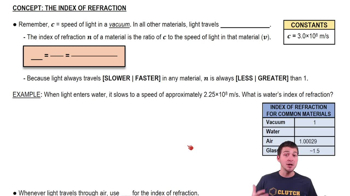
The index of refraction (n) is a dimensionless number that describes how much light slows down in a medium compared to its speed in a vacuum. It is defined as the ratio of the speed of light in vacuum to the speed of light in the medium. A higher index indicates that light travels slower in that medium, which affects how light rays are bent when entering or exiting the material.
Recommended video:
Guided course
03:46
Index of Refraction

Lens Maker's Equation

The Lens Maker's Equation relates the focal length of a lens to the radii of curvature of its surfaces and the index of refraction. For a spherical surface, this equation helps determine how light rays converge or diverge after passing through the lens. In the context of a transparent sphere, it can be used to find the index of refraction by analyzing the focal point of the light rays as they pass through the sphere.
Recommended video:
05:38
Lens Maker Equation
Related Practice
Textbook Question

BIO A dentist uses a curved mirror to view the back side of teeth in the upper jaw. Suppose she wants an upright image with a magnification of 1.5 when the mirror is 1.2 cm from a tooth. Should she use a convex or a concave mirror? What focal length should it have?

1
views
Textbook Question

There's one angle of incidence β onto a prism for which the light inside an isosceles prism travels parallel to the base and emerges at angle β. A laboratory measurement finds that β=52.2° for a prism shaped like an equilateral triangle. What is the prism's index of refraction?

1
views
Textbook Question

You're visiting the shark tank at the aquarium when you see a 2.5-m-long shark that appears to be swimming straight toward you at 2.0 m/s. What is the shark's actual speed through the water? You can ignore the glass wall of the tank.

2
views
Textbook Question

Optical engineers need to know the cone of acceptance of an optical fiber. This is the maximum angle that an entering light ray can make with the axis of the fiber if it is to be guided down the fiber. What is the cone of acceptance of an optical fiber for which the index of refraction of the core is 1.55 while that of the cladding is 1.45? You can model the fiber as a cylinder with a flat entrance face.

1
views
Textbook Question

A 2.0-cm-tall candle flame is 2.0 m from a wall. You happen to have a lens with a focal length of 32 cm. How many places can you put the lens to form a well-focused image of the candle flame on the wall? For each location, what are the height and orientation of the image?

1
views
Textbook Question

BIO A keratometer is an optical device used to measure the radius of curvature of the eye's cornea—its entrance surface. This measurement is especially important when fitting contact lenses, which must match the cornea's curvature. Most light incident on the eye is transmitted into the eye, but some light reflects from the cornea, which, due to its curvature, acts like a convex mirror. The keratometer places a small, illuminated ring of known diameter 7.5 cm in front of the eye. The optometrist, using an eyepiece, looks through the center of this ring and sees a small virtual image of the ring that appears to be behind the cornea. The optometrist uses a scale inside the eyepiece to measure the diameter of the image and calculate its magnification. Suppose the optometrist finds that the magnification for one patient is 0.049. What is the absolute value of the radius of curvature of her cornea?

2
views