
Ch 34: Ray Optics
Knight Calc - Physics for Scientists and Engineers 5th Edition
Knight Calc5th EditionPhysics for Scientists and EngineersISBN: 9780137344796Not the one you use?Change textbook
Chapter 34, Problem 56

Optical engineers need to know the cone of acceptance of an optical fiber. This is the maximum angle that an entering light ray can make with the axis of the fiber if it is to be guided down the fiber. What is the cone of acceptance of an optical fiber for which the index of refraction of the core is 1.55 while that of the cladding is 1.45? You can model the fiber as a cylinder with a flat entrance face.

Verified step by step guidance
1
The cone of acceptance is determined by the critical angle at which total internal reflection occurs at the core-cladding interface. Start by identifying the indices of refraction: the core has an index of refraction \( n_{\text{core}} = 1.55 \) and the cladding has \( n_{\text{cladding}} = 1.45 \).
The critical angle \( \theta_c \) is the angle of incidence at the core-cladding boundary beyond which total internal reflection occurs. Use the formula for the critical angle: \( \sin(\theta_c) = \frac{n_{\text{cladding}}}{n_{\text{core}}} \). Substitute the given values into this equation.
The cone of acceptance is related to the critical angle through Snell's law at the entrance face of the fiber. At the entrance, the light ray enters from air (\( n_{\text{air}} = 1.00 \)) into the core. Use Snell's law: \( n_{\text{air}} \sin(\theta_{\text{acceptance}}) = n_{\text{core}} \sin(\theta_c) \). Rearrange this equation to solve for \( \sin(\theta_{\text{acceptance}}) \).
Calculate \( \sin(\theta_{\text{acceptance}}) \) using the values of \( \sin(\theta_c) \) from the previous step and \( n_{\text{air}} \). Then, find \( \theta_{\text{acceptance}} \) by taking the inverse sine (arcsin) of \( \sin(\theta_{\text{acceptance}}) \).
The cone of acceptance is twice the angle \( \theta_{\text{acceptance}} \), as it represents the full angular range of light that can enter the fiber and be guided. Multiply \( \theta_{\text{acceptance}} \) by 2 to find the total cone of acceptance.

Verified video answer for a similar problem:

This video solution was recommended by our tutors as helpful for the problem above.
Was this helpful?

Key Concepts

Here are the essential concepts you must grasp in order to answer the question correctly.

Index of Refraction

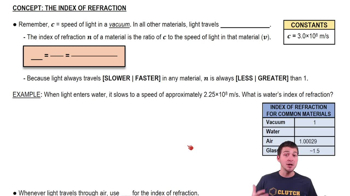
The index of refraction is a dimensionless number that describes how light propagates through a medium. It is defined as the ratio of the speed of light in a vacuum to the speed of light in the medium. In optical fibers, the core has a higher index of refraction than the cladding, which allows for total internal reflection, a key principle for guiding light within the fiber.
Recommended video:
Guided course
03:46
Index of Refraction

Total Internal Reflection

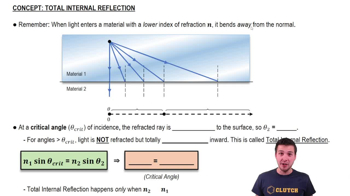
Total internal reflection occurs when a light ray traveling in a medium with a higher index of refraction hits the boundary of a medium with a lower index at an angle greater than the critical angle. This phenomenon is essential for optical fibers, as it ensures that light remains confined within the core, allowing for efficient transmission of signals over long distances.
Recommended video:
Guided course
05:29
Total Internal Reflection

Cone of Acceptance

The cone of acceptance defines the range of angles at which light can enter an optical fiber and still be guided through it. It is determined by the indices of refraction of the core and cladding, and is typically represented as a cone shape extending from the fiber's axis. Understanding this concept is crucial for designing optical systems that maximize light coupling into the fiber.
Recommended video:
Related Practice
Textbook Question

There's one angle of incidence β onto a prism for which the light inside an isosceles prism travels parallel to the base and emerges at angle β. A laboratory measurement finds that β=52.2° for a prism shaped like an equilateral triangle. What is the prism's index of refraction?

1
views
Textbook Question

Shown from above in FIGURE P34.54 is one corner of a rectangular box filled with water. A laser beam starts 10 cm from side A of the container and enters the water at position x. You can ignore the thin walls of the container. If x = 15 cm, does the laser beam refract back into the air through side B or reflect from side B back into the water? Determine the angle of refraction or reflection.

1
views
Textbook Question

Shown from above in FIGURE P34.54 is one corner of a rectangular box filled with water. A laser beam starts 10 cm from side A of the container and enters the water at position x. You can ignore the thin walls of the container. Find the minimum value of x for which the laser beam passes through side B and emerges into the air.

2
views
Textbook Question

You're visiting the shark tank at the aquarium when you see a 2.5-m-long shark that appears to be swimming straight toward you at 2.0 m/s. What is the shark's actual speed through the water? You can ignore the glass wall of the tank.

2
views
Textbook Question

Paraxial light rays approach a transparent sphere parallel to an optical axis passing through the center of the sphere. The rays come to a focus on the far surface of the sphere. What is the sphere's index of refraction?

1
views
Textbook Question

A horizontal laser beam enters the glass prism shown in FIGURE P34.55. When the laser beam exits the prism, by what angle will it have been deflected from horizontal?

1
views