Ch 34: Ray Optics
Knight Calc - Physics for Scientists and Engineers 5th Edition
Knight Calc5th EditionPhysics for Scientists and EngineersISBN: 9780137344796Not the one you use?Change textbook
Chapter 34, Problem 13

The glass core of an optical fiber has an index of refraction 1.60. The index of refraction of the cladding is 1.48. What is the maximum angle a light ray can make with the wall of the core if it is to remain inside the fiber?

Verified step by step guidance
1
Identify the concept: This problem involves total internal reflection in an optical fiber. The critical angle is the key to determining the maximum angle a light ray can make with the wall of the core while staying inside the fiber.
Calculate the critical angle: Use the formula for the critical angle \( \theta_c \) at the core-cladding interface: \( \sin(\theta_c) = \frac{n_2}{n_1} \), where \( n_1 = 1.60 \) (core) and \( n_2 = 1.48 \) (cladding). Solve for \( \theta_c \) using \( \theta_c = \arcsin\left(\frac{n_2}{n_1}\right) \).
Relate the critical angle to the maximum angle inside the fiber: The maximum angle a light ray can make with the wall of the core is related to the critical angle by geometry. The angle of incidence inside the core, \( \theta_i \), is complementary to the angle the ray makes with the wall. Thus, \( \theta_i = 90^\circ - \theta_c \).
Determine the maximum angle with the wall: The maximum angle a light ray can make with the wall of the core is \( \theta_{max} = 90^\circ - \theta_i \). Substitute \( \theta_i \) from the previous step to find \( \theta_{max} = \theta_c \).
Summarize the process: To find the maximum angle, calculate the critical angle using the indices of refraction, then use the relationship between the critical angle and the geometry of the fiber to determine the maximum angle with the wall.

Verified video answer for a similar problem:

This video solution was recommended by our tutors as helpful for the problem above.
Was this helpful?

Key Concepts

Here are the essential concepts you must grasp in order to answer the question correctly.

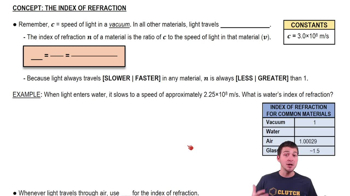
Index of Refraction

The index of refraction is a dimensionless number that describes how light propagates through a medium. It is defined as the ratio of the speed of light in a vacuum to the speed of light in the medium. A higher index indicates that light travels slower in that medium, affecting how light bends when entering or exiting different materials.
Recommended video:
Guided course
03:46
Index of Refraction

Total Internal Reflection

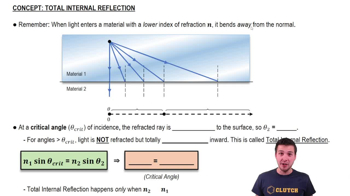
Total internal reflection occurs when a light ray traveling in a denser medium hits the boundary of a less dense medium at an angle greater than the critical angle. This phenomenon allows light to be completely reflected back into the denser medium, which is essential for the functioning of optical fibers, ensuring that light remains confined within the core.
Recommended video:
Guided course
05:29
Total Internal Reflection

Critical Angle

The critical angle is the minimum angle of incidence at which total internal reflection occurs. It can be calculated using the indices of refraction of the two media involved. For optical fibers, knowing the critical angle helps determine the maximum angle at which light can enter the fiber while still being guided effectively within the core.
Recommended video:
Guided course
01:04
Critical Angle