Ch 34: Ray Optics
Knight Calc - Physics for Scientists and Engineers 5th Edition
Knight Calc5th EditionPhysics for Scientists and EngineersISBN: 9780137344796Not the one you use?Change textbook
Chapter 34, Problem 19

To a fish in an aquarium, the 4.00-mm-thick walls appear to be only 3.50 mm thick. What is the index of refraction of the walls?

Verified step by step guidance
1
Step 1: Understand the problem. The apparent thickness of the aquarium wall is less than its actual thickness due to refraction. This phenomenon occurs because light bends when it passes from one medium to another. The relationship between the actual thickness, apparent thickness, and the index of refraction can be expressed using the formula: n=dactualdapparent, where n is the index of refraction, dactual is the actual thickness, and dapparent is the apparent thickness.
Step 2: Identify the given values. From the problem, the actual thickness of the aquarium wall is 4.00-mm, and the apparent thickness is 3.50-mm. These values will be substituted into the formula to calculate the index of refraction.
Step 3: Write the formula for the index of refraction. The formula is: n=dactualdapparent. This equation relates the actual thickness, apparent thickness, and the index of refraction.
Step 4: Substitute the given values into the formula. Replace dactual with 4.00 and dapparent with 3.50. The equation becomes: n=4.003.50.
Step 5: Simplify the fraction to find the index of refraction. Perform the division 4.003.50 to calculate the value of n. This will give the index of refraction of the aquarium walls.

Verified video answer for a similar problem:

This video solution was recommended by our tutors as helpful for the problem above.
Was this helpful?

Key Concepts

Here are the essential concepts you must grasp in order to answer the question correctly.

Refraction

Refraction is the bending of light as it passes from one medium to another with a different density. This phenomenon occurs due to changes in the speed of light in different materials, which can cause objects to appear distorted or shifted in position. Understanding refraction is essential for analyzing how light interacts with the aquarium walls and affects the perceived thickness.
Recommended video:
Guided course
03:46
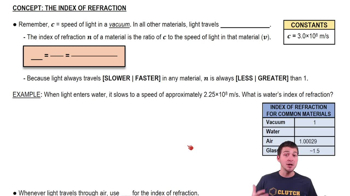
Index of Refraction

Index of Refraction

The index of refraction (n) is a dimensionless number that describes how much light slows down in a medium compared to its speed in a vacuum. It is defined as the ratio of the speed of light in a vacuum to the speed of light in the medium. The index of refraction is crucial for determining how light behaves at the interface between different materials, such as the aquarium walls and water.
Recommended video:
Guided course
03:46
Index of Refraction

Apparent Thickness

Apparent thickness refers to the perceived thickness of an object when viewed through a different medium, influenced by the refraction of light. In this scenario, the fish perceives the aquarium walls as thinner than they actually are due to the bending of light at the water-wall interface. This concept is key to solving the problem, as it relates the actual thickness of the walls to the perceived thickness experienced by the fish.
Recommended video:
07:49
Ray Diagrams for Convex Mirrors