Ch 34: Ray Optics
Knight Calc - Physics for Scientists and Engineers 5th Edition
Knight Calc5th EditionPhysics for Scientists and EngineersISBN: 9780137344796Not the one you use?Change textbook
Chapter 34, Problem 25

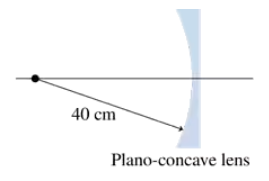
Find the focal length of the plano-concave polystyrene plastic lens in FIGURE EX34.25.

Verified step by step guidance
1
Step 1: Understand the lens type and its geometry. A plano-concave lens has one flat surface and one inwardly curved surface. The focal length of such a lens can be calculated using the lens maker's formula.
Step 2: Write the lens maker's formula: \( \frac{1}{f} = (n - 1) \left( \frac{1}{R_1} - \frac{1}{R_2} \right) \), where \( f \) is the focal length, \( n \) is the refractive index of the lens material, \( R_1 \) is the radius of curvature of the first surface, and \( R_2 \) is the radius of curvature of the second surface.
Step 3: Identify the values from the problem. For a plano-concave lens, \( R_1 \) (flat surface) is infinite, so \( \frac{1}{R_1} = 0 \). \( R_2 \) is the radius of curvature of the concave surface, which is given as 40 cm. The refractive index of polystyrene plastic is approximately \( n = 1.59 \).
Step 4: Substitute the values into the lens maker's formula: \( \frac{1}{f} = (1.59 - 1) \left( 0 - \frac{1}{-40} \right) \). Note that the negative sign for \( R_2 \) is due to the concave surface.
Step 5: Simplify the equation to find \( f \). Rearrange the formula to solve for \( f \), ensuring proper handling of the negative sign and refractive index. This will yield the focal length of the plano-concave lens.

Verified video answer for a similar problem:

This video solution was recommended by our tutors as helpful for the problem above.
Was this helpful?

Key Concepts

Here are the essential concepts you must grasp in order to answer the question correctly.

Focal Length

The focal length of a lens is the distance from the lens to the focal point, where parallel rays of light converge or appear to diverge. For a plano-concave lens, which is a diverging lens, the focal length is negative, indicating that the focal point is virtual and located on the same side as the incoming light.
Recommended video:
Guided course
10:54
Spinning on a string of variable length

Lens Maker's Equation

The Lens Maker's Equation relates the focal length of a lens to the radii of curvature of its surfaces and the refractive index of the material. It is given by the formula: 1/f = (n - 1) * (1/R1 - 1/R2), where f is the focal length, n is the refractive index, and R1 and R2 are the radii of curvature of the lens surfaces. This equation is essential for calculating the focal length of lenses with different shapes.
Recommended video:
05:38
Lens Maker Equation

Plano-Concave Lens

A plano-concave lens has one flat (plano) surface and one inwardly curved (concave) surface. This type of lens diverges light rays that are incident on it, causing them to spread out. The curvature of the concave surface determines the lens's focal length, which is crucial for applications in optics where light manipulation is required.
Recommended video:
07:58
Thin Lens Equation