Ch 34: Ray Optics
Knight Calc - Physics for Scientists and Engineers 5th Edition
Knight Calc5th EditionPhysics for Scientists and EngineersISBN: 9780137344796Not the one you use?Change textbook
Chapter 34, Problem 28

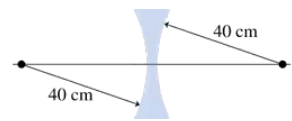
Find the focal length of the glass lens in FIGURE EX34.28.

Verified step by step guidance
1
Step 1: Identify the type of lens shown in the figure. The lens in the image is a diverging lens, as it causes parallel rays to spread out and appear to originate from a focal point on the same side as the incoming light.
Step 2: Recall the lens formula: \( \frac{1}{f} = \frac{1}{d_o} + \frac{1}{d_i} \), where \( f \) is the focal length, \( d_o \) is the object distance, and \( d_i \) is the image distance. For a diverging lens, the focal length \( f \) is negative.
Step 3: From the figure, observe that the object distance \( d_o \) is 40 cm and the image distance \( d_i \) is also 40 cm. Note that for a diverging lens, the image distance \( d_i \) is negative because the image is virtual and on the same side as the object.
Step 4: Substitute the values into the lens formula: \( \frac{1}{f} = \frac{1}{40} + \frac{1}{-40} \). Simplify the equation to find \( \frac{1}{f} \).
Step 5: Solve for \( f \) by taking the reciprocal of \( \frac{1}{f} \). The result will give the focal length of the lens, which will be negative, indicating a diverging lens.

Verified video answer for a similar problem:

This video solution was recommended by our tutors as helpful for the problem above.
Was this helpful?

Key Concepts

Here are the essential concepts you must grasp in order to answer the question correctly.

Focal Length

The focal length of a lens is the distance from the lens to the focal point, where parallel rays of light converge or appear to diverge. It is a crucial parameter in lens optics, determining how strongly the lens converges or diverges light. The focal length can be positive for converging lenses and negative for diverging lenses.
Recommended video:
Guided course
10:54
Spinning on a string of variable length

Lens Maker's Equation

The Lens Maker's Equation relates the focal length of a lens to the radii of curvature of its two surfaces and the refractive index of the lens material. It is expressed as 1/f = (n - 1) * (1/R1 - 1/R2), where f is the focal length, n is the refractive index, and R1 and R2 are the radii of curvature of the lens surfaces. This equation is essential for calculating the focal length based on the lens geometry.
Recommended video:
05:38
Lens Maker Equation

Ray Diagrams

Ray diagrams are graphical representations used to illustrate how light rays interact with lenses. They help visualize the paths of light as they pass through the lens, showing how they converge or diverge. By drawing the principal rays, such as the parallel ray, the focal ray, and the central ray, one can determine the image location and characteristics, which are vital for understanding lens behavior.
Recommended video:
06:37
Ray Diagrams for Converging Lenses