Ch 34: Ray Optics
Knight Calc - Physics for Scientists and Engineers 5th Edition
Knight Calc5th EditionPhysics for Scientists and EngineersISBN: 9780137344796Not the one you use?Change textbook
Chapter 34, Problem 12

A costume jewelry pendant made of cubic zirconia is submerged in oil. A light ray in the oil strikes one face of the zirconia crystal at an angle of incidence of 25°. Once inside, what is the ray's angle with respect to the face of the crystal?

Verified step by step guidance
1
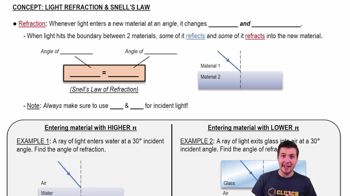
Identify the relevant physics concept: This problem involves the refraction of light, which is governed by Snell's Law. Snell's Law is expressed as: n1sinθ1=n2sinθ2, where n1 and n2 are the refractive indices of the two media, and θ1 and θ2 are the angles of incidence and refraction, respectively.
Determine the refractive indices: Look up the refractive index of oil (n1) and cubic zirconia (n2). For example, the refractive index of oil is approximately 1.46, and the refractive index of cubic zirconia is approximately 2.15.
Apply Snell's Law: Substitute the known values into Snell's Law. For this problem, n1=1.46, θ1=25°, and n2=2.15. The equation becomes: 1.46sin25°=2.15sinθ2.
Solve for the angle of refraction: Rearrange the equation to isolate sinθ2: sinθ2=1.46sin25°2.15. Then, calculate θ2 by taking the inverse sine of the result: θ2=sin11.46sin25°2.15.
Interpret the result: The angle θ2 is the angle of refraction inside the cubic zirconia. To find the ray's angle with respect to the face of the crystal, subtract θ2 from 90°: 90°θ2. This gives the desired angle.

Verified video answer for a similar problem:

This video solution was recommended by our tutors as helpful for the problem above.
Was this helpful?

Key Concepts

Here are the essential concepts you must grasp in order to answer the question correctly.

Snell's Law

Snell's Law describes how light rays change direction when they pass from one medium to another. It states that the ratio of the sine of the angle of incidence to the sine of the angle of refraction is constant and is equal to the ratio of the velocities of light in the two media. This principle is essential for determining the angle of the light ray as it enters the cubic zirconia from the oil.
Recommended video:

Refractive Index

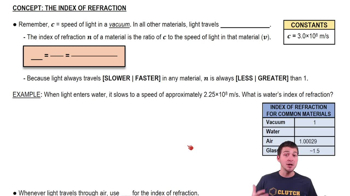
The refractive index is a dimensionless number that describes how fast light travels in a medium compared to its speed in a vacuum. Each material has a specific refractive index, which affects how much light bends when entering or exiting the material. For cubic zirconia and oil, knowing their refractive indices is crucial for applying Snell's Law to find the angle of refraction.
Recommended video:
Guided course
03:46
Index of Refraction

Angle of Incidence and Angle of Refraction

The angle of incidence is the angle between the incoming light ray and the normal (perpendicular) line to the surface at the point of incidence. The angle of refraction is the angle between the refracted ray and the normal. Understanding these angles is vital for calculating how the light ray behaves as it transitions from oil into the cubic zirconia crystal.
Recommended video:
Guided course
01:04
Critical Angle