Ch 34: Ray Optics
Knight Calc - Physics for Scientists and Engineers 5th Edition
Knight Calc5th EditionPhysics for Scientists and EngineersISBN: 9780137344796Not the one you use?Change textbook
Chapter 34, Problem 10

A 1.0-cm-thick layer of water stands on a horizontal slab of glass. A light ray in the air is incident on the water 60° from the normal. What is the ray's direction of travel in the glass?

Verified step by step guidance
1
Identify the key concepts involved: This problem involves refraction of light, which is governed by Snell's Law. Snell's Law is expressed as: n1sinθ1=n2sinθ2, where n1 and n2 are the refractive indices of the two media, and θ1 and θ2 are the angles of incidence and refraction, respectively.
Determine the refractive indices: The refractive index of air is approximately n=1.0. The refractive index of water is approximately n=1.33, and the refractive index of glass is approximately n=1.5. These values will be used in Snell's Law.
Apply Snell's Law at the air-water interface: The light ray first travels from air into water. Using Snell's Law, substitute the known values: 1.0sin60°=1.33sinθwater. Solve for θwater, the angle of refraction in the water.
Apply Snell's Law at the water-glass interface: Once the light ray enters the water, it will then refract again as it passes into the glass. Use Snell's Law again: 1.33sinθwater=1.5sinθglass. Solve for θglass, the angle of refraction in the glass.
Interpret the result: The final angle of refraction in the glass, θglass, represents the direction of travel of the light ray in the glass relative to the normal. Ensure that all angles are measured with respect to the normal and verify the continuity of the light path through the media.

Verified video answer for a similar problem:

This video solution was recommended by our tutors as helpful for the problem above.
Was this helpful?

Key Concepts

Here are the essential concepts you must grasp in order to answer the question correctly.

Refraction

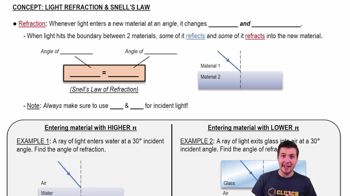
Refraction is the bending of light as it passes from one medium to another with a different density, which changes its speed. This phenomenon is governed by Snell's Law, which relates the angles of incidence and refraction to the indices of refraction of the two media. Understanding refraction is crucial for predicting how light will change direction when entering materials like water and glass.
Recommended video:
Guided course
03:46
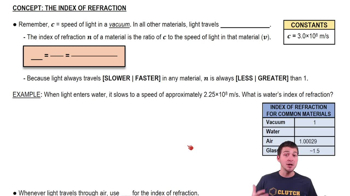
Index of Refraction

Snell's Law

Snell's Law mathematically describes the relationship between the angle of incidence and the angle of refraction when light travels between two different media. It is expressed as n1 * sin(θ1) = n2 * sin(θ2), where n represents the refractive indices and θ represents the angles. This law is essential for calculating the new direction of light as it transitions from air to water and then to glass.
Recommended video:

Refractive Index

The refractive index is a dimensionless number that describes how much light slows down in a medium compared to its speed in a vacuum. Each material has a specific refractive index, which influences how light bends when entering or exiting the material. For example, water has a refractive index of about 1.33, while glass typically ranges from 1.5 to 1.9, affecting the light's path significantly.
Recommended video:
Guided course
03:46
Index of Refraction