Ch 33: Wave Optics
Knight Calc - Physics for Scientists and Engineers 5th Edition
Knight Calc5th EditionPhysics for Scientists and EngineersISBN: 9780137344796Not the one you use?Change textbook
Chapter 33, Problem 43

Two vertical, high-frequency radio antennas are 20 m apart. 2.0 km away, in a plane parallel to the plane of the antennas, 'bright' spots of radio intensity are spaced 5.0 m apart, separated by spots with almost no radio intensity. What is the radio frequency?

Verified step by step guidance
1
Determine the type of interference pattern: The problem describes alternating 'bright' and 'dark' spots, which indicates constructive and destructive interference. This is a result of the wave nature of radio waves and their superposition.
Use the formula for constructive interference: The condition for constructive interference is given by \( d \sin \theta = m \lambda \), where \( d \) is the distance between the antennas (20 m), \( \theta \) is the angle of the bright spot relative to the central axis, \( m \) is the order of the bright spot (an integer), and \( \lambda \) is the wavelength of the radio waves.
Relate the geometry to the interference pattern: The bright spots are spaced 5.0 m apart at a distance of 2.0 km (2000 m) from the antennas. The angle \( \theta \) for each bright spot can be approximated using \( \tan \theta \approx \sin \theta \approx \frac{x}{L} \), where \( x \) is the spacing between bright spots (5.0 m) and \( L \) is the distance to the observation plane (2000 m).
Calculate the wavelength \( \lambda \): Substitute \( \sin \theta \approx \frac{x}{L} \) into the interference condition \( d \sin \theta = m \lambda \). For the first-order bright spot (\( m = 1 \)), this simplifies to \( \lambda = \frac{d \cdot x}{L} \).
Determine the frequency \( f \): Use the wave equation \( v = f \lambda \), where \( v \) is the speed of the radio waves (equal to the speed of light, \( 3.0 \times 10^8 \ \text{m/s} \)). Rearrange to find \( f = \frac{v}{\lambda} \). Substitute the calculated \( \lambda \) into this equation to find the radio frequency.

Verified video answer for a similar problem:

This video solution was recommended by our tutors as helpful for the problem above.
Was this helpful?

Key Concepts

Here are the essential concepts you must grasp in order to answer the question correctly.

Interference Patterns

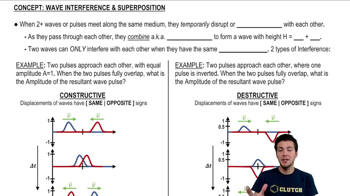
Interference patterns occur when two or more waves overlap, leading to regions of constructive and destructive interference. In this scenario, the bright spots represent areas of constructive interference where the radio waves from the antennas reinforce each other, while the dark spots indicate destructive interference where the waves cancel each other out.
Recommended video:
Guided course
03:47
Wave Interference & Superposition

Wavelength and Frequency Relationship

The relationship between wavelength (λ) and frequency (f) of a wave is described by the equation v = fλ, where v is the speed of the wave. For radio waves, this speed is approximately the speed of light in a vacuum. Understanding this relationship is crucial for calculating the frequency based on the observed spacing of the bright spots.
Recommended video:
Guided course
05:08
Circumference, Period, and Frequency in UCM

Path Difference

Path difference is the difference in distance traveled by two waves arriving at a point. For constructive interference to occur at the bright spots, the path difference must be an integer multiple of the wavelength. In this problem, the geometry of the antennas and the distance to the observation plane will help determine the path difference and, consequently, the frequency of the radio waves.
Recommended video:
Guided course
08:20
Mean Free Path