Ch 33: Wave Optics
Knight Calc - Physics for Scientists and Engineers 5th Edition
Knight Calc5th EditionPhysics for Scientists and EngineersISBN: 9780137344796Not the one you use?Change textbook
Chapter 33, Problem 37

A Michelson interferometer uses red light with a wavelength of 656.45 nm from a hydrogen discharge lamp. How many bright-dark-bright fringe shifts are observed if mirror M₂ is moved exactly 1 cm?

Verified step by step guidance
1
Understand the concept: In a Michelson interferometer, fringe shifts occur when one of the mirrors is moved, causing a change in the optical path length. Each fringe shift corresponds to a change in the path length equal to one wavelength of the light used.
Calculate the total change in the optical path length: When mirror M₂ is moved by a distance \( d \), the optical path length changes by \( 2d \) because the light travels to the mirror and back. Here, \( d = 1 \; \text{cm} = 0.01 \; \text{m} \).
Determine the number of wavelengths in the total path length change: The number of fringe shifts \( N \) is given by \( N = \frac{2d}{\lambda} \), where \( \lambda \) is the wavelength of the light. Substitute \( \lambda = 656.45 \; \text{nm} = 656.45 \times 10^{-9} \; \text{m} \).
Substitute the values into the formula: Replace \( d \) and \( \lambda \) in the equation \( N = \frac{2d}{\lambda} \) to calculate the number of fringe shifts.
Interpret the result: The calculated value of \( N \) represents the total number of bright-dark-bright fringe shifts observed as the mirror is moved by 1 cm.

Verified video answer for a similar problem:

This video solution was recommended by our tutors as helpful for the problem above.
Video duration:
3m
Was this helpful?

Key Concepts

Here are the essential concepts you must grasp in order to answer the question correctly.

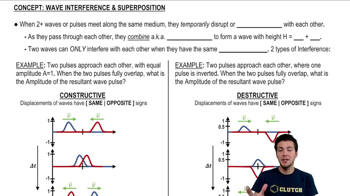
Interference

Interference is a phenomenon that occurs when two or more waves overlap and combine to form a new wave pattern. In the context of the Michelson interferometer, constructive interference leads to bright fringes, while destructive interference results in dark fringes. The pattern of these fringes is crucial for analyzing the changes in path length caused by moving mirrors.
Recommended video:
Guided course
03:47
Wave Interference & Superposition

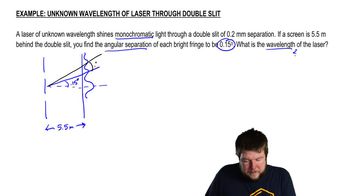
Wavelength

Wavelength is the distance between successive peaks of a wave, typically measured in nanometers (nm) for light. In this question, the red light has a wavelength of 656.45 nm, which is essential for calculating the number of fringe shifts. The wavelength determines how many times the light wave can fit into the distance moved by the mirror.
Recommended video:
Guided course
05:42
Unknown Wavelength of Laser through Double Slit

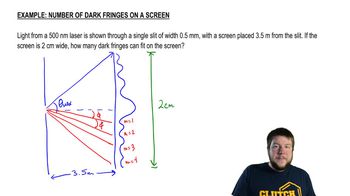
Fringe Shift Calculation

Fringe shift calculation involves determining how many times the light wave's path length changes in relation to its wavelength when a mirror is moved. For every full wavelength (2 times the distance moved by the mirror), a bright fringe shifts to a dark fringe or vice versa. Thus, moving mirror M₂ by 1 cm will result in a specific number of fringe shifts based on the wavelength of the light used.
Recommended video:
Guided course
09:05
Number of Dark Fringes on a Screen