
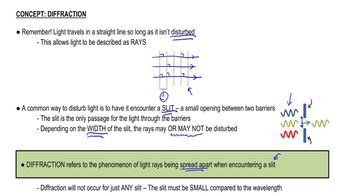

Two 50-μm-wide slits spaced 0.25 mm apart are illuminated by blue laser light with a wavelength of 450 nm. The interference pattern is observed on a screen 2.0 m behind the slits. How many bright fringes are seen in the central maximum that spans the distance between the first missing order on one side and the first missing order on the other side?
Light from a helium-neon laser (λ = 633 nm) passes through a circular aperture and is observed on a screen 4.0 m behind the aperture. The width of the central maximum is 2.5 cm. What is the diameter (in mm) of the hole?
Verified step by step guidance
Verified video answer for a similar problem:
Key Concepts
Diffraction
Central Maximum
Wavelength and Aperture Size Relationship
Infrared light of wavelength 2.5 μm illuminates a 0.20-mm-diameter hole. What is the angle of the first dark fringe in radians? In degrees?
Your artist friend is designing an exhibit inspired by circular-aperture diffraction. A pinhole in a red zone is going to be illuminated with a red laser beam of wavelength 670 nm, while a pinhole in a violet zone is going to be illuminated with a violet laser beam of wavelength 410 nm. She wants all the diffraction patterns seen on a distant screen to have the same size. For this to work, what must be the ratio of the red pinhole’s diameter to that of the violet pinhole?
FIGURE P33.39 shows the light intensity on a screen 2.5 m behind an aperture. The aperture is illuminated with light of wavelength 620 nm. Is the aperture a single slit or a double slit? Explain.
You want to photograph a circular diffraction pattern whose central maximum has a diameter of 1.0 cm. You have a helium-neon laser (λ=633 nm) and a 0.12-mm-diameter pinhole. How far behind the pinhole should you place the screen that's to be photographed?
A Michelson interferometer uses red light with a wavelength of 656.45 nm from a hydrogen discharge lamp. How many bright-dark-bright fringe shifts are observed if mirror M₂ is moved exactly 1 cm?
