Ch 33: Wave Optics
Knight Calc - Physics for Scientists and Engineers 5th Edition
Knight Calc5th EditionPhysics for Scientists and EngineersISBN: 9780137344796Not the one you use?Change textbook
Chapter 33, Problem 29

Two 50-μm-wide slits spaced 0.25 mm apart are illuminated by blue laser light with a wavelength of 450 nm. The interference pattern is observed on a screen 2.0 m behind the slits. How many bright fringes are seen in the central maximum that spans the distance between the first missing order on one side and the first missing order on the other side?

Verified step by step guidance
1
Step 1: Understand the problem. The question involves a double-slit interference pattern and asks for the number of bright fringes in the central maximum. The central maximum spans the region between the first missing order on one side and the first missing order on the other side. Missing orders occur when the diffraction condition overlaps with the interference condition.
Step 2: Recall the formula for the position of bright fringes in a double-slit interference pattern: \( y_m = \frac{m \lambda L}{d} \), where \( m \) is the fringe order, \( \lambda \) is the wavelength of light, \( L \) is the distance to the screen, and \( d \) is the slit separation. This formula helps determine the positions of the bright fringes.
Step 3: Identify the condition for missing orders. Missing orders occur when the interference maxima coincide with the minima of the single-slit diffraction pattern. The diffraction minima are given by \( a \sin \theta = n \lambda \), where \( a \) is the slit width, \( n \) is the diffraction order, and \( \lambda \) is the wavelength. Use this condition to find the first missing order.
Step 4: Calculate the maximum fringe order \( m \) visible within the central maximum. The central maximum spans the region between the first missing order on one side and the first missing order on the other side. Use the relationship between the slit width \( a \), slit separation \( d \), and wavelength \( \lambda \) to determine the range of \( m \).
Step 5: Count the number of bright fringes within the central maximum. The number of bright fringes corresponds to the integer values of \( m \) that fit within the range defined by the first missing orders on either side. Ensure the calculation accounts for symmetry around the central axis.

Verified video answer for a similar problem:

This video solution was recommended by our tutors as helpful for the problem above.
Was this helpful?

Key Concepts

Here are the essential concepts you must grasp in order to answer the question correctly.

Double-Slit Interference

Double-slit interference is a phenomenon that occurs when coherent light passes through two closely spaced slits, creating an interference pattern of bright and dark fringes on a screen. The pattern results from the constructive and destructive interference of light waves emanating from the two slits, depending on their path difference. This concept is fundamental in understanding how light behaves as both a wave and a particle.
Recommended video:
Guided course
12:00
Young's Double Slit Experiment

Wavelength and Fringe Spacing

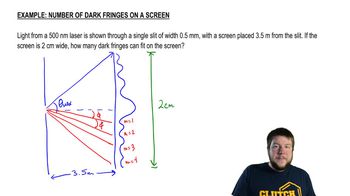
The wavelength of light is the distance between successive peaks of the wave, which influences the spacing of the interference fringes. In a double-slit experiment, the distance between bright fringes on the screen is directly proportional to the wavelength and inversely proportional to the slit separation. This relationship is crucial for calculating the positions of the bright and dark fringes in the interference pattern.
Recommended video:
Guided course
09:05
Number of Dark Fringes on a Screen

Missing Orders in Interference Patterns

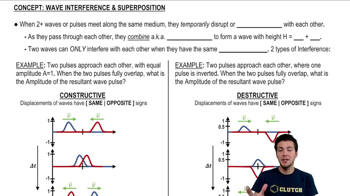
Missing orders in interference patterns refer to specific angles where no bright fringes are observed due to destructive interference. These occur when the path difference between light waves from the two slits equals an odd multiple of half the wavelength. Understanding how to identify and calculate these missing orders is essential for determining the total number of visible bright fringes in the central maximum.
Recommended video:
Guided course
03:47
Wave Interference & Superposition
Related Practice
Textbook Question

Infrared light of wavelength 2.5 μm illuminates a 0.20-mm-diameter hole. What is the angle of the first dark fringe in radians? In degrees?

2
views

Textbook Question

Your artist friend is designing an exhibit inspired by circular-aperture diffraction. A pinhole in a red zone is going to be illuminated with a red laser beam of wavelength 670 nm, while a pinhole in a violet zone is going to be illuminated with a violet laser beam of wavelength 410 nm. She wants all the diffraction patterns seen on a distant screen to have the same size. For this to work, what must be the ratio of the red pinhole’s diameter to that of the violet pinhole?

1
views
Textbook Question

Light of 630 nm wavelength illuminates a single slit of width 0.15 mm. FIGURE EX33.22 shows the intensity pattern seen on a screen behind the slit. What is the distance to the screen?

1
views
Textbook Question

Light from a helium-neon laser (λ = 633 nm) passes through a circular aperture and is observed on a screen 4.0 m behind the aperture. The width of the central maximum is 2.5 cm. What is the diameter (in mm) of the hole?

1
views
Textbook Question

Figure EX33.26 shows the light intensity on a screen behind a single slit. The wavelength of the light is 600 nm and the slit width is 0.15 mm. What is the distance from the slit to the screen?

2
views
Textbook Question

Light of 600 nm wavelength passes through a single slit and creates a 2.0-cm-wide central maximum on a screen behind the slit. What wavelength of light will create a 3.0-cm-wide central maximum on a screen twice as far away?

1
views