
Ch 33: Wave Optics
Knight Calc - Physics for Scientists and Engineers 5th Edition
Knight Calc5th EditionPhysics for Scientists and EngineersISBN: 9780137344796Not the one you use?Change textbook
Chapter 33, Problem 24

Light of 600 nm wavelength passes through a single slit and creates a 2.0-cm-wide central maximum on a screen behind the slit. What wavelength of light will create a 3.0-cm-wide central maximum on a screen twice as far away?

Verified step by step guidance
1
Understand the problem: The central maximum width in a single-slit diffraction pattern is determined by the wavelength of light, the slit width, and the distance to the screen. The relationship is given by the formula for the angular width of the central maximum: \( \Delta \theta = \frac{2 \lambda}{a} \), where \( \lambda \) is the wavelength, and \( a \) is the slit width. The linear width on the screen is related to \( \Delta \theta \) and the screen distance \( L \).
Express the linear width of the central maximum as \( w = 2L \tan(\Delta \theta / 2) \). For small angles, \( \tan(\Delta \theta / 2) \approx \Delta \theta / 2 \), so \( w \approx \frac{2 \lambda L}{a} \). This shows that the width \( w \) is proportional to both the wavelength \( \lambda \) and the screen distance \( L \).
Set up the ratio of the two cases: Let \( \lambda_1 = 600 \ \text{nm} \), \( w_1 = 2.0 \ \text{cm} \), \( w_2 = 3.0 \ \text{cm} \), and \( L_2 = 2L_1 \). Using the proportionality \( w \propto \lambda L \), write \( \frac{w_2}{w_1} = \frac{\lambda_2 L_2}{\lambda_1 L_1} \).
Substitute \( L_2 = 2L_1 \) into the ratio: \( \frac{w_2}{w_1} = \frac{\lambda_2 (2L_1)}{\lambda_1 L_1} \). Simplify to get \( \frac{w_2}{w_1} = 2 \cdot \frac{\lambda_2}{\lambda_1} \).
Solve for \( \lambda_2 \): Rearrange the equation to find \( \lambda_2 = \frac{w_2}{2w_1} \cdot \lambda_1 \). Substitute the known values of \( w_1 \), \( w_2 \), and \( \lambda_1 \) to calculate \( \lambda_2 \).

Verified video answer for a similar problem:

This video solution was recommended by our tutors as helpful for the problem above.
Was this helpful?

Key Concepts

Here are the essential concepts you must grasp in order to answer the question correctly.

Single Slit Diffraction

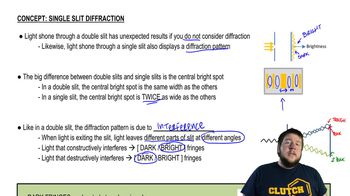
Single slit diffraction occurs when light passes through a narrow opening, causing it to spread out and create a pattern of light and dark bands on a screen. The width of the central maximum is influenced by the wavelength of the light and the width of the slit. This phenomenon is described by the diffraction formula, which relates the angle of the minima to the wavelength and slit width.
Recommended video:
Guided course
12:33
Single Slit Diffraciton

Wavelength and Central Maximum Width

The width of the central maximum in a diffraction pattern is directly related to the wavelength of the light used. A longer wavelength results in a wider central maximum, while a shorter wavelength produces a narrower one. This relationship is crucial for predicting how changes in wavelength will affect the observed diffraction pattern.
Recommended video:
Guided course
05:42
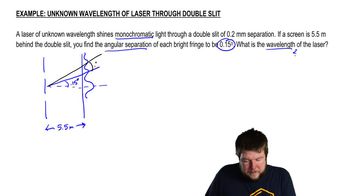
Unknown Wavelength of Laser through Double Slit

Geometric Relationships in Diffraction

In diffraction experiments, the distance from the slit to the screen affects the size of the diffraction pattern. When the screen is moved further away, the central maximum expands. The relationship between the width of the central maximum, the distance to the screen, and the wavelength can be expressed mathematically, allowing for calculations of how changes in these parameters influence the observed pattern.
Recommended video:
Related Practice
Textbook Question

Two 50-μm-wide slits spaced 0.25 mm apart are illuminated by blue laser light with a wavelength of 450 nm. The interference pattern is observed on a screen 2.0 m behind the slits. How many bright fringes are seen in the central maximum that spans the distance between the first missing order on one side and the first missing order on the other side?

1
views
Textbook Question

Your artist friend is designing an exhibit inspired by circular-aperture diffraction. A pinhole in a red zone is going to be illuminated with a red laser beam of wavelength 670 nm, while a pinhole in a violet zone is going to be illuminated with a violet laser beam of wavelength 410 nm. She wants all the diffraction patterns seen on a distant screen to have the same size. For this to work, what must be the ratio of the red pinhole’s diameter to that of the violet pinhole?

1
views
Textbook Question

In a single-slit experiment, the slit width is 200 times the wavelength of the light. What is the width (in mm) of the central maximum on a screen 2.0 m behind the slit?

1
views
Textbook Question

Light of 630 nm wavelength illuminates a single slit of width 0.15 mm. FIGURE EX33.22 shows the intensity pattern seen on a screen behind the slit. What is the distance to the screen?

1
views
Textbook Question

Figure EX33.26 shows the light intensity on a screen behind a single slit. The wavelength of the light is 600 nm and the slit width is 0.15 mm. What is the distance from the slit to the screen?

2
views
Textbook Question

FIGURE EX33.17 shows the interference pattern on a screen 1.0 m behind an 800 lines/mm diffraction grating. What is the wavelength (in nm) of the light?

1
views