Ch 33: Wave Optics
Knight Calc - Physics for Scientists and Engineers 5th Edition
Knight Calc5th EditionPhysics for Scientists and EngineersISBN: 9780137344796Not the one you use?Change textbook
Chapter 33, Problem 40b

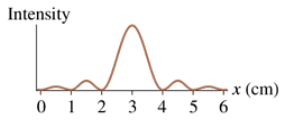
FIGURE P33.40 shows the light intensity on a screen 2.5 m behind an aperture. The aperture is illuminated with light of wavelength 620 nm. If the aperture is a single slit, what is its width? If it is a double slit, what is the spacing between the slits?

Verified step by step guidance
1
Step 1: Analyze the intensity graph provided. The graph shows a central maximum at x = 3 cm and smaller maxima on either side, which suggests diffraction and interference patterns. For a single slit, the central maximum is wider, while for a double slit, the pattern includes evenly spaced maxima due to interference.
Step 2: For a single slit, use the formula for the angular position of the first minimum: \( \sin \theta = \frac{\lambda}{a} \), where \( \lambda \) is the wavelength of light, \( a \) is the slit width, and \( \theta \) is the angle corresponding to the first minimum. The angle \( \theta \) can be approximated using \( \tan \theta \approx \sin \theta \approx \frac{x}{L} \), where \( x \) is the distance from the central maximum to the first minimum on the screen, and \( L \) is the distance from the aperture to the screen.
Step 3: For a double slit, use the formula for the angular position of the maxima: \( \sin \theta = \frac{m \lambda}{d} \), where \( m \) is the order of the maximum, \( \lambda \) is the wavelength of light, \( d \) is the slit spacing, and \( \theta \) is the angle corresponding to the maxima. Similar to the single slit case, \( \theta \) can be approximated using \( \tan \theta \approx \sin \theta \approx \frac{x}{L} \).
Step 4: Measure the distance \( x \) from the graph. For the single slit, \( x \) corresponds to the distance from the central maximum to the first minimum. For the double slit, \( x \) corresponds to the distance between adjacent maxima. Use the given wavelength \( \lambda = 620 \) nm and screen distance \( L = 2.5 \) m to calculate \( \theta \).
Step 5: Substitute the values of \( \lambda \), \( x \), and \( L \) into the respective formulas to solve for \( a \) (single slit width) or \( d \) (double slit spacing). Ensure the units are consistent (e.g., convert \( \lambda \) to meters).

Verified video answer for a similar problem:

This video solution was recommended by our tutors as helpful for the problem above.
Was this helpful?

Key Concepts

Here are the essential concepts you must grasp in order to answer the question correctly.

Diffraction

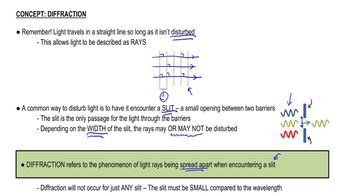
Diffraction is the bending of waves around obstacles and the spreading of waves when they pass through narrow openings. In the context of light, diffraction patterns are created when light waves encounter an aperture, leading to variations in intensity on a screen. The width of the aperture affects the degree of diffraction, which is crucial for determining the aperture size based on the observed intensity pattern.
Recommended video:

Single and Double Slit Experiments

The single and double slit experiments are foundational demonstrations of wave behavior in light. A single slit produces a diffraction pattern characterized by a central maximum and diminishing side maxima, while a double slit creates an interference pattern with multiple bright and dark fringes. The spacing of the slits in a double slit setup influences the distance between these fringes, which can be calculated using the wavelength of light and the geometry of the setup.
Recommended video:
Guided course
12:00
Young's Double Slit Experiment

Wavelength and Intensity Relationship

The wavelength of light, measured in nanometers (nm), is a critical factor in determining the diffraction and interference patterns observed on a screen. The intensity of light at various points is influenced by the constructive and destructive interference of waves, which depends on the wavelength. In this problem, the wavelength of 620 nm is essential for calculating the aperture width or slit spacing based on the observed intensity distribution.
Recommended video:
Guided course
02:32
Wave Intensity
Related Practice
Textbook Question

White light (400–700 nm) incident on a 600 lines/mm diffraction grating produces rainbows of diffracted light. What is the width of the first-order rainbow on a screen 2.0 m behind the grating?

1
views

Textbook Question

FIGURE P33.39 shows the light intensity on a screen 2.5 m behind an aperture. The aperture is illuminated with light of wavelength 620 nm. Is the aperture a single slit or a double slit? Explain.

2
views
Textbook Question

Two vertical, high-frequency radio antennas are 20 m apart. 2.0 km away, in a plane parallel to the plane of the antennas, 'bright' spots of radio intensity are spaced 5.0 m apart, separated by spots with almost no radio intensity. What is the radio frequency?

1
views
Textbook Question

You want to photograph a circular diffraction pattern whose central maximum has a diameter of 1.0 cm. You have a helium-neon laser (λ=633 nm) and a 0.12-mm-diameter pinhole. How far behind the pinhole should you place the screen that's to be photographed?

1
views
Textbook Question

Helium atoms emit light at several wavelengths. Light from a helium lamp illuminates a diffraction grating and is observed on a screen 50.00 cm behind the grating. The emission at wavelength 501.5 nm creates a first-order bright fringe 21.90 cm from the central maximum. What is the wavelength of the bright fringe that is 31.60 cm from the central maximum?

1
views
Textbook Question

A Michelson interferometer uses red light with a wavelength of 656.45 nm from a hydrogen discharge lamp. How many bright-dark-bright fringe shifts are observed if mirror M₂ is moved exactly 1 cm?

1
views