Ch 33: Wave Optics
Knight Calc - Physics for Scientists and Engineers 5th Edition
Knight Calc5th EditionPhysics for Scientists and EngineersISBN: 9780137344796Not the one you use?Change textbook
Chapter 33, Problem 45

Helium atoms emit light at several wavelengths. Light from a helium lamp illuminates a diffraction grating and is observed on a screen 50.00 cm behind the grating. The emission at wavelength 501.5 nm creates a first-order bright fringe 21.90 cm from the central maximum. What is the wavelength of the bright fringe that is 31.60 cm from the central maximum?

Verified step by step guidance
1
Step 1: Understand the problem. The diffraction grating equation is used to relate the wavelength of light to the position of bright fringes on a screen. The equation is: dsinθ=mλ, where d is the grating spacing, θ is the diffraction angle, m is the order of the fringe, and λ is the wavelength. The problem provides the wavelength for one fringe and asks for the wavelength of another fringe at a different position.
Step 2: Calculate the diffraction angle for the first-order bright fringe at 21.90 cm. Use the geometry of the setup: tanθ=yL, where y is the distance from the central maximum (21.90 cm) and L is the distance to the screen (50.00 cm). Solve for θ using θ=tansup1yL.
Step 3: Use the diffraction grating equation to calculate the grating spacing d. Rearrange the equation to solve for d: d=mλsinθ. Substitute the known values for m (1), λ (501.5 nm), and θ (calculated in Step 2).
Step 4: Calculate the diffraction angle for the bright fringe at 31.60 cm using the same geometry as in Step 2. Use θ=tansup1yL, where y is now 31.60 cm.
Step 5: Use the diffraction grating equation to calculate the wavelength of the bright fringe at 31.60 cm. Rearrange the equation to solve for λ: λ=dsinθ. Substitute the values for d (calculated in Step 3) and θ (calculated in Step 4).

Verified video answer for a similar problem:

This video solution was recommended by our tutors as helpful for the problem above.
Was this helpful?

Key Concepts

Here are the essential concepts you must grasp in order to answer the question correctly.

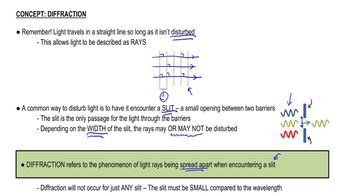
Diffraction Grating

A diffraction grating is an optical component with a periodic structure that disperses light into its component wavelengths. When light passes through or reflects off the grating, it creates interference patterns due to the superposition of light waves. The angles at which bright and dark fringes appear depend on the wavelength of the light and the spacing of the grating lines.
Recommended video:

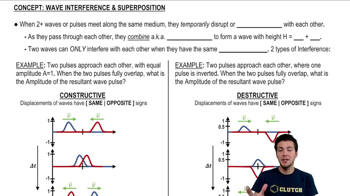
Interference Patterns

Interference patterns arise when two or more coherent light waves overlap, resulting in regions of constructive and destructive interference. Bright fringes occur where waves reinforce each other, while dark fringes occur where they cancel out. The position of these fringes is determined by the wavelength of the light and the geometry of the setup, such as the distance from the grating to the screen.
Recommended video:
Guided course
03:47
Wave Interference & Superposition

Wavelength Calculation

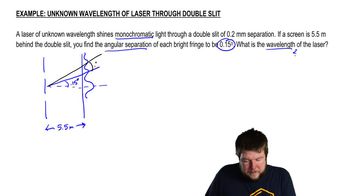
The wavelength of light can be calculated using the formula for diffraction patterns, which relates the position of the fringes to the wavelength, the distance to the screen, and the grating spacing. For first-order fringes, the relationship is given by the equation d sin(θ) = mλ, where d is the grating spacing, θ is the angle of the fringe, m is the order of the fringe, and λ is the wavelength. This allows for the determination of unknown wavelengths based on measured fringe positions.
Recommended video:
Guided course
05:42
Unknown Wavelength of Laser through Double Slit