
Ch 33: Wave Optics
Knight Calc - Physics for Scientists and Engineers 5th Edition
Knight Calc5th EditionPhysics for Scientists and EngineersISBN: 9780137344796Not the one you use?Change textbook
Chapter 33, Problem 64b

A radar for tracking aircraft broadcasts a 12 GHz microwave beam from a 2.0-m-diameter circular radar antenna. From a wave perspective, the antenna is a circular aperture through which the microwaves diffract. If the antenna emits 100 kW of power, what is the average microwave intensity at 30 km?

Verified step by step guidance
1
Step 1: Understand the problem. The radar antenna emits microwaves at a frequency of 12 GHz and has a diameter of 2.0 m. The power emitted is 100 kW, and we need to calculate the average microwave intensity at a distance of 30 km. Intensity is defined as power per unit area, and the area at 30 km corresponds to the surface area of a sphere with radius 30 km.
Step 2: Calculate the wavelength of the microwave beam. The relationship between frequency \( f \) and wavelength \( \lambda \) is given by \( \lambda = \frac{c}{f} \), where \( c \) is the speed of light (\( 3 \times 10^8 \; \text{m/s} \)). Substitute \( f = 12 \; \text{GHz} \; (12 \times 10^9 \; \text{Hz}) \) into the formula.
Step 3: Determine the surface area of the sphere at 30 km. The formula for the surface area of a sphere is \( A = 4 \pi r^2 \), where \( r \) is the radius. Here, \( r = 30 \; \text{km} \; (30 \times 10^3 \; \text{m}) \). Substitute this value into the formula to find \( A \).
Step 4: Calculate the average intensity. Intensity \( I \) is defined as \( I = \frac{P}{A} \), where \( P \) is the power emitted (100 kW or \( 100 \times 10^3 \; \text{W} \)) and \( A \) is the surface area calculated in Step 3. Substitute the values of \( P \) and \( A \) into the formula.
Step 5: Interpret the result. The average intensity represents the power per unit area of the microwave beam at a distance of 30 km. This value can be used to understand the distribution of energy from the radar antenna over a large distance.

Verified video answer for a similar problem:

This video solution was recommended by our tutors as helpful for the problem above.
Was this helpful?

Key Concepts

Here are the essential concepts you must grasp in order to answer the question correctly.

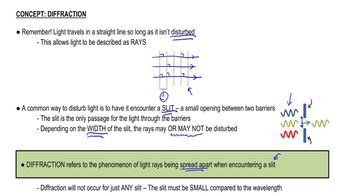
Diffraction

Diffraction is the bending of waves around obstacles and the spreading of waves when they pass through an aperture. In the context of the radar antenna, the circular aperture causes the emitted microwave beam to spread out as it travels, affecting how the intensity of the signal diminishes with distance.
Recommended video:

Intensity of Waves

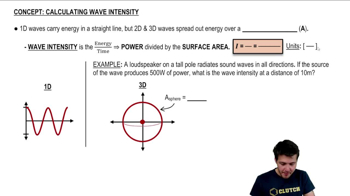
Intensity is defined as the power per unit area carried by a wave. For electromagnetic waves like microwaves, intensity can be calculated by dividing the total power emitted by the area over which the power is distributed. As the distance from the source increases, the intensity decreases due to the spreading of the wavefront.
Recommended video:
Guided course
02:32
Wave Intensity

Antenna Gain and Effective Aperture

Antenna gain refers to the ability of an antenna to direct radio frequency energy in a particular direction compared to an isotropic radiator. The effective aperture is a measure of how well an antenna can receive power from incoming waves. These concepts are crucial for understanding how the radar antenna's size and design influence the intensity of the microwaves at a given distance.
Recommended video:
Guided course
07:40
The Doppler Effect
Related Practice
Textbook Question

Light of wavelength 600 nm passes though two slits separated by 0.20 mm and is observed on a screen 1.0 m behind the slits. The location of the central maximum is marked on the screen and labeled y = 0. A very thin piece of glass is then placed in one slit. Because light travels slower in glass than in air, the wave passing through the glass is delayed by 5.0×10⁻¹⁶ s in comparison to the wave going through the other slit. What fraction of the period of the light wave is this delay?

2
views
Textbook Question

Light of wavelength 600 nm passes though two slits separated by 0.20 mm and is observed on a screen 1.0 m behind the slits. The location of the central maximum is marked on the screen and labeled y = 0. With the glass in place, what is the phase difference Δϕ0 between the two waves as they leave the slits?

Textbook Question

A helium-neon laser (λ = 633 nm) is built with a glass tube of inside diameter 1.0 mm, as shown in FIGURE P33.62. One mirror is partially transmitting to allow the laser beam out. An electrical discharge in the tube causes it to glow like a neon light. From an optical perspective, the laser beam is a light wave that diffracts out through a 1.0-mm-diameter circular opening. Can a laser beam be perfectly parallel, with no spreading? Why or why not?

1
views
Textbook Question

A helium-neon laser (λ = 633 nm) is built with a glass tube of inside diameter 1.0 mm, as shown in FIGURE P33.62. One mirror is partially transmitting to allow the laser beam out. An electrical discharge in the tube causes it to glow like a neon light. From an optical perspective, the laser beam is a light wave that diffracts out through a 1.0-mm-diameter circular opening. What is the diameter (in mm) of the laser beam after it travels 3.0 m? Note that the wave model is appropriate because the spreading, at this distance, is significantly larger than the size of the opening.

1
views
Textbook Question

A Michelson interferometer operating at a 600 nm wavelength has a 2.00-cm-long glass cell in one arm. To begin, the air is pumped out of the cell and mirror M₂ is adjusted to produce a bright spot at the center of the interference pattern. Then a valve is opened and air is slowly admitted into the cell. The index of refraction of air at 1.00 atm pressure is 1.00028. How many bright-dark-bright fringe shifts are observed as the cell fills with air?

1
views
Textbook Question

A diffraction grating has slit spacing d. Fringes are viewed on a screen at distance L. Find an expression for the wavelength of light that produces a first-order fringe on the viewing screen at distance L from the center of the screen.

1
views