

Ch 33: Wave Optics
Knight Calc - Physics for Scientists and Engineers 5th Edition
Knight Calc5th EditionPhysics for Scientists and EngineersISBN: 9780137344796Not the one you use?Change textbook
Chapter 33, Problem 67c

Light of wavelength 600 nm passes though two slits separated by 0.20 mm and is observed on a screen 1.0 m behind the slits. The location of the central maximum is marked on the screen and labeled y = 0. With the glass in place, what is the phase difference Δϕ0 between the two waves as they leave the slits?

Verified step by step guidance
1
Identify the key parameters given in the problem: the wavelength of light (λ = 600 nm = 600 × 10⁻⁹ m), the slit separation (d = 0.20 mm = 0.20 × 10⁻³ m), and the distance to the screen (L = 1.0 m). The problem asks for the phase difference Δϕ₀ between the two waves as they leave the slits.
Recall that the phase difference Δϕ₀ between two waves is related to the path difference Δx by the formula: Δϕ₀ = (2π/λ) × Δx. Here, Δx is the difference in the distances traveled by the two waves from the slits to the observation point.
For the central maximum (y = 0), the path difference Δx is zero because the waves travel the same distance to the screen. However, if a glass is placed in front of one slit, it introduces an additional optical path difference due to the refractive index of the glass. Let the thickness of the glass be t and its refractive index be n. The optical path difference introduced is Δx = t(n - 1).
Substitute the expression for Δx into the phase difference formula: Δϕ₀ = (2π/λ) × t(n - 1). This equation relates the phase difference to the thickness of the glass, its refractive index, and the wavelength of the light.
To calculate Δϕ₀, you would need the values of t (thickness of the glass) and n (refractive index of the glass). If these values are provided, substitute them into the formula to find the phase difference. If not, the problem cannot be solved numerically but the relationship is established.

Verified video answer for a similar problem:

This video solution was recommended by our tutors as helpful for the problem above.
Was this helpful?

Key Concepts

Here are the essential concepts you must grasp in order to answer the question correctly.

Wave Interference

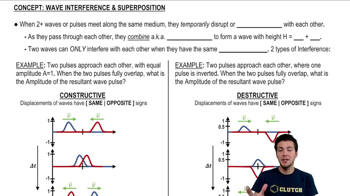
Wave interference occurs when two or more waves overlap, resulting in a new wave pattern. In the context of light passing through slits, constructive interference leads to bright spots on the screen, while destructive interference results in dark spots. The phase difference between the waves from the two slits is crucial in determining the interference pattern observed.
Recommended video:
Guided course
03:47
Wave Interference & Superposition

Phase Difference

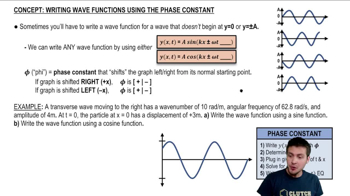
Phase difference refers to the difference in the phase of two waves at a given point in time. It is measured in radians or degrees and is essential for understanding how waves interact. In this scenario, the phase difference Δϕ<sub>0</sub> between the light waves from the two slits will determine the position of the interference maxima and minima on the screen.
Recommended video:
Guided course
08:59
Phase Constant of a Wave Function

Young's Double Slit Experiment

Young's Double Slit Experiment demonstrates the wave nature of light through the observation of interference patterns created by light passing through two closely spaced slits. The distance between the slits, the wavelength of light, and the distance to the screen all influence the resulting pattern. This experiment is foundational in understanding concepts like phase difference and wave interference.
Recommended video:
Guided course
12:00
Young's Double Slit Experiment
Related Practice
Textbook Question

Light of wavelength 600 nm passes though two slits separated by 0.20 mm and is observed on a screen 1.0 m behind the slits. The location of the central maximum is marked on the screen and labeled y = 0. A very thin piece of glass is then placed in one slit. Because light travels slower in glass than in air, the wave passing through the glass is delayed by 5.0×10⁻¹⁶ s in comparison to the wave going through the other slit. What fraction of the period of the light wave is this delay?

2
views
Textbook Question

A radar for tracking aircraft broadcasts a 12 GHz microwave beam from a 2.0-m-diameter circular radar antenna. From a wave perspective, the antenna is a circular aperture through which the microwaves diffract. If the antenna emits 100 kW of power, what is the average microwave intensity at 30 km?

1
views
Textbook Question

A double-slit experiment is set up using a helium-neon laser (λ = 633 nm). Then a very thin piece of glass (n = 1.50) is placed over one of the slits. Afterward, the central point on the screen is occupied by what had been the m = 10 dark fringe. How thick is the glass?

1
views
Textbook Question

A helium-neon laser (λ = 633 nm) is built with a glass tube of inside diameter 1.0 mm, as shown in FIGURE P33.62. One mirror is partially transmitting to allow the laser beam out. An electrical discharge in the tube causes it to glow like a neon light. From an optical perspective, the laser beam is a light wave that diffracts out through a 1.0-mm-diameter circular opening. What is the diameter (in mm) of the laser beam after it travels 3.0 m? Note that the wave model is appropriate because the spreading, at this distance, is significantly larger than the size of the opening.

1
views
Textbook Question

A Michelson interferometer operating at a 600 nm wavelength has a 2.00-cm-long glass cell in one arm. To begin, the air is pumped out of the cell and mirror M₂ is adjusted to produce a bright spot at the center of the interference pattern. Then a valve is opened and air is slowly admitted into the cell. The index of refraction of air at 1.00 atm pressure is 1.00028. How many bright-dark-bright fringe shifts are observed as the cell fills with air?

1
views
Textbook Question

FIGURE CP33.73 shows two nearly overlapped intensity peaks of the sort you might produce with a diffraction grating (see Figure 33.9b). As a practical matter, two peaks can just barely be resolved if their spacing Δy equals the width w of each peak, where w is measured at half of the peak’s height. Two peaks closer together than w will merge into a single peak. We can use this idea to understand the resolution of a diffraction grating. In the small-angle approximation, the position of the m = 1 peak of a diffraction grating falls at the same location as the m = 1 fringe of a double slit: y1 = λL/d. Suppose two wavelengths differing by Δλ pass through a grating at the same time. Find an expression for Δy, the separation of their first-order peaks.

2
views