
Light of wavelength 600 nm passes though two slits separated by 0.20 mm and is observed on a screen 1.0 m behind the slits. The location of the central maximum is marked on the screen and labeled y = 0. A very thin piece of glass is then placed in one slit. Because light travels slower in glass than in air, the wave passing through the glass is delayed by 5.0×10⁻¹⁶ s in comparison to the wave going through the other slit. What fraction of the period of the light wave is this delay?
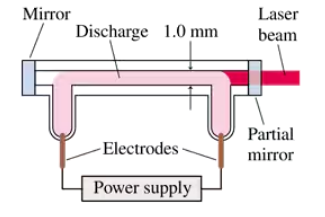
A helium-neon laser (λ = 633 nm) is built with a glass tube of inside diameter 1.0 mm, as shown in FIGURE P33.62. One mirror is partially transmitting to allow the laser beam out. An electrical discharge in the tube causes it to glow like a neon light. From an optical perspective, the laser beam is a light wave that diffracts out through a 1.0-mm-diameter circular opening. What is the diameter (in mm) of the laser beam after it travels 3.0 m? Note that the wave model is appropriate because the spreading, at this distance, is significantly larger than the size of the opening.

Verified step by step guidance
Verified video answer for a similar problem:
Key Concepts
Diffraction
Wave Model of Light
Beam Divergence
Light of wavelength 600 nm passes though two slits separated by 0.20 mm and is observed on a screen 1.0 m behind the slits. The location of the central maximum is marked on the screen and labeled y = 0. With the glass in place, what is the phase difference Δϕ0 between the two waves as they leave the slits?
A helium-neon laser (λ = 633 nm) is built with a glass tube of inside diameter 1.0 mm, as shown in FIGURE P33.62. One mirror is partially transmitting to allow the laser beam out. An electrical discharge in the tube causes it to glow like a neon light. From an optical perspective, the laser beam is a light wave that diffracts out through a 1.0-mm-diameter circular opening. Can a laser beam be perfectly parallel, with no spreading? Why or why not?
A radar for tracking aircraft broadcasts a 12 GHz microwave beam from a 2.0-m-diameter circular radar antenna. From a wave perspective, the antenna is a circular aperture through which the microwaves diffract. If the antenna emits 100 kW of power, what is the average microwave intensity at 30 km?
Use your expression from part a to find an expression for the separation Δy on the screen of two fringes that differ in wavelength by Δλ.
A diffraction grating has slit spacing d. Fringes are viewed on a screen at distance L. Find an expression for the wavelength of light that produces a first-order fringe on the viewing screen at distance L from the center of the screen.
