
Ch 33: Wave Optics
Knight Calc - Physics for Scientists and Engineers 5th Edition
Knight Calc5th EditionPhysics for Scientists and EngineersISBN: 9780137344796Not the one you use?Change textbook
Chapter 33, Problem 62a

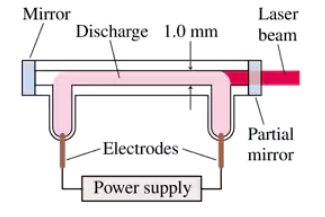
A helium-neon laser (λ = 633 nm) is built with a glass tube of inside diameter 1.0 mm, as shown in FIGURE P33.62. One mirror is partially transmitting to allow the laser beam out. An electrical discharge in the tube causes it to glow like a neon light. From an optical perspective, the laser beam is a light wave that diffracts out through a 1.0-mm-diameter circular opening. Can a laser beam be perfectly parallel, with no spreading? Why or why not?

Verified step by step guidance
1
Step 1: Understand the concept of diffraction. Diffraction occurs when a wave encounters an obstacle or opening, causing the wave to bend and spread. For light waves, this spreading is governed by the wave's wavelength (λ) and the size of the aperture (diameter of the opening).
Step 2: Recall the formula for the angular width of the central diffraction maximum for a circular aperture: θ ≈ 1.22 * (λ / D), where θ is the angular width, λ is the wavelength of the light, and D is the diameter of the aperture. This formula shows that the spreading of the beam depends on the ratio of the wavelength to the aperture size.
Step 3: Substitute the given values into the formula. The wavelength of the helium-neon laser is λ = 633 nm (or 633 × 10⁻⁹ m), and the diameter of the aperture is D = 1.0 mm (or 1.0 × 10⁻³ m). This will allow you to calculate the angular width θ.
Step 4: Interpret the result conceptually. Even though the laser beam is highly collimated, diffraction ensures that it cannot be perfectly parallel. The angular spreading θ represents the unavoidable divergence of the beam due to the wave nature of light.
Step 5: Conclude that a laser beam cannot be perfectly parallel because diffraction causes it to spread. This is a fundamental property of waves and is dictated by the aperture size and wavelength of the light.

Verified video answer for a similar problem:

This video solution was recommended by our tutors as helpful for the problem above.
Was this helpful?

Key Concepts

Here are the essential concepts you must grasp in order to answer the question correctly.

Diffraction

Diffraction is the bending of waves around obstacles and openings. When a light wave passes through a small aperture, such as the 1.0 mm opening in the laser tube, it spreads out rather than traveling in a perfectly straight line. This phenomenon is more pronounced when the size of the opening is comparable to the wavelength of the light, which in this case is 633 nm, leading to the conclusion that a perfectly parallel beam is not achievable.
Recommended video:

Laser Beam Characteristics

A laser beam is characterized by its coherence, monochromaticity, and directionality. While lasers produce highly collimated light, meaning the light rays are parallel and focused, they cannot achieve absolute parallelism due to diffraction effects. The finite size of the laser aperture and the wave nature of light inherently limit the degree of collimation, resulting in some spreading of the beam.
Recommended video:
Guided course
13:40
Beam supporting an object

Wave-Particle Duality

Wave-particle duality is a fundamental concept in quantum mechanics that describes how light exhibits both wave-like and particle-like properties. In the context of lasers, this duality explains why light behaves as a wave when it diffracts through an aperture. Understanding this concept is crucial for grasping why a laser beam cannot be perfectly parallel, as the wave nature leads to inherent limitations in beam spreading.
Recommended video:
Guided course
07:19
Intro to Waves and Wave Speed
Related Practice
Textbook Question

Light of wavelength 600 nm passes though two slits separated by 0.20 mm and is observed on a screen 1.0 m behind the slits. The location of the central maximum is marked on the screen and labeled y = 0. A very thin piece of glass is then placed in one slit. Because light travels slower in glass than in air, the wave passing through the glass is delayed by 5.0×10⁻¹⁶ s in comparison to the wave going through the other slit. What fraction of the period of the light wave is this delay?

2
views
Textbook Question

A radar for tracking aircraft broadcasts a 12 GHz microwave beam from a 2.0-m-diameter circular radar antenna. From a wave perspective, the antenna is a circular aperture through which the microwaves diffract. If the antenna emits 100 kW of power, what is the average microwave intensity at 30 km?

1
views
Textbook Question

Use your expression from part a to find an expression for the separation Δy on the screen of two fringes that differ in wavelength by Δλ.

1
views
Textbook Question

White light (400–700 nm) incident on a 600 lines/mm diffraction grating produces rainbows of diffracted light. What is the width of the first-order rainbow on a screen 2.0 m behind the grating?

1
views
Textbook Question

A helium-neon laser (λ = 633 nm) is built with a glass tube of inside diameter 1.0 mm, as shown in FIGURE P33.62. One mirror is partially transmitting to allow the laser beam out. An electrical discharge in the tube causes it to glow like a neon light. From an optical perspective, the laser beam is a light wave that diffracts out through a 1.0-mm-diameter circular opening. What is the diameter (in mm) of the laser beam after it travels 3.0 m? Note that the wave model is appropriate because the spreading, at this distance, is significantly larger than the size of the opening.

1
views
Textbook Question

A diffraction grating has slit spacing d. Fringes are viewed on a screen at distance L. Find an expression for the wavelength of light that produces a first-order fringe on the viewing screen at distance L from the center of the screen.

1
views