Ch 32: AC Circuits
Knight Calc - Physics for Scientists and Engineers 5th Edition
Knight Calc5th EditionPhysics for Scientists and EngineersISBN: 9780137344796Not the one you use?Change textbook
Chapter 32, Problem 38

The motor of an electric drill draws a 3.5 A rms current at the power-line voltage of 120 V rms. What is the motor's power if the current lags the voltage by 20°?

Verified step by step guidance
1
Step 1: Recall the formula for calculating the real power (P) in an AC circuit: \( P = V_{\text{rms}} \cdot I_{\text{rms}} \cdot \cos(\phi) \), where \( V_{\text{rms}} \) is the root mean square voltage, \( I_{\text{rms}} \) is the root mean square current, and \( \phi \) is the phase angle between the current and voltage.
Step 2: Identify the given values from the problem: \( V_{\text{rms}} = 120 \; \text{V} \), \( I_{\text{rms}} = 3.5 \; \text{A} \), and \( \phi = 20^\circ \).
Step 3: Convert the phase angle \( \phi \) from degrees to radians if necessary, as some calculations may require it. Use the conversion formula \( \phi_{\text{radians}} = \phi_{\text{degrees}} \cdot \frac{\pi}{180} \).
Step 4: Substitute the given values into the power formula: \( P = 120 \cdot 3.5 \cdot \cos(20^\circ) \).
Step 5: Use a calculator or trigonometric table to find \( \cos(20^\circ) \), then multiply the values to compute the motor's real power. Ensure the units of the final result are in watts (W).

Verified video answer for a similar problem:

This video solution was recommended by our tutors as helpful for the problem above.
Was this helpful?

Key Concepts

Here are the essential concepts you must grasp in order to answer the question correctly.

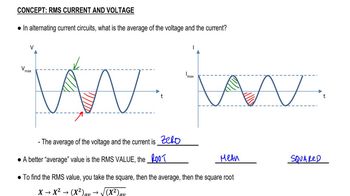
RMS Current and Voltage

RMS (Root Mean Square) values represent the effective values of alternating current (AC) and voltage. For AC circuits, RMS values allow for the calculation of power as they provide a measure equivalent to a DC value that would deliver the same power. In this case, the drill operates at 3.5 A rms and 120 V rms, which are essential for determining the power consumed.
Recommended video:
Guided course
07:14
RMS Current and Voltage

Power Factor

The power factor is a measure of how effectively electrical power is being converted into useful work output. It is defined as the cosine of the phase angle (φ) between the current and voltage waveforms. In this scenario, with a phase lag of 20°, the power factor can be calculated as cos(20°), which is crucial for determining the real power consumed by the motor.
Recommended video:

Real Power Calculation

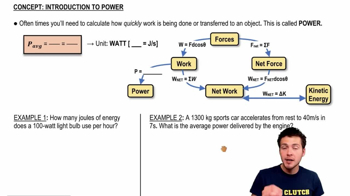
Real power, measured in watts (W), is the actual power consumed by an electrical device to perform work. It can be calculated using the formula P = V_rms * I_rms * power factor. For the electric drill, substituting the given values of voltage, current, and the calculated power factor will yield the motor's real power output.
Recommended video: