Ch 32: AC Circuits
Knight Calc - Physics for Scientists and Engineers 5th Edition
Knight Calc5th EditionPhysics for Scientists and EngineersISBN: 9780137344796Not the one you use?Change textbook
Chapter 32, Problem 34

The heating element of a toaster dissipates 1500 W when connected to a 120 V/60 Hz power line. What is its resistance?

Verified step by step guidance
1
Start by recalling the formula for electrical power dissipation in terms of voltage and resistance: P = V2 / R, where P is the power, V is the voltage, and R is the resistance.
Rearrange the formula to solve for resistance R: R = V2 / P.
Substitute the given values into the formula: V = 120 volts and P = 1500 watts.
Square the voltage: V2 = 120^2.
Divide the squared voltage by the power to find the resistance: R = 120^2 / 1500.

Verified video answer for a similar problem:

This video solution was recommended by our tutors as helpful for the problem above.
Was this helpful?

Key Concepts

Here are the essential concepts you must grasp in order to answer the question correctly.

Ohm's Law

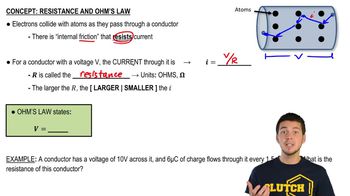
Ohm's Law states that the current (I) flowing through a conductor between two points is directly proportional to the voltage (V) across the two points and inversely proportional to the resistance (R) of the conductor. It is mathematically expressed as V = I * R. This relationship is fundamental in electrical circuits and helps in calculating resistance when voltage and current are known.
Recommended video:
Guided course
03:07
Resistance and Ohm's Law

Power in Electrical Circuits

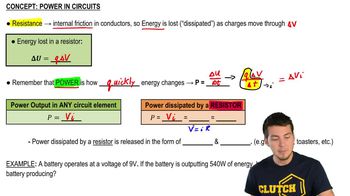
The power (P) dissipated in an electrical circuit is the rate at which energy is used or converted and is calculated using the formula P = V * I, where V is voltage and I is current. In the context of resistive devices like a toaster, power can also be expressed as P = I^2 * R or P = V^2 / R, allowing for the calculation of resistance when power and voltage are known.
Recommended video:
Guided course
06:18
Power in Circuits

Resistance

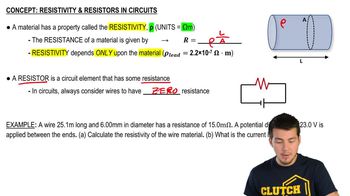
Resistance (R) is a measure of the opposition to the flow of electric current in a conductor. It is measured in ohms (Ω) and depends on the material, length, and cross-sectional area of the conductor. In the context of the toaster, calculating resistance is essential to understand how efficiently it converts electrical energy into heat, which is crucial for its operation.
Recommended video:
Guided course
05:25
Resistivity & Resistors in Circuits