Ch 32: AC Circuits
Knight Calc - Physics for Scientists and Engineers 5th Edition
Knight Calc5th EditionPhysics for Scientists and EngineersISBN: 9780137344796Not the one you use?Change textbook
Chapter 32, Problem 39

A series RLC circuit with a 100 Ω resistor dissipates 80 W when attached to a 120 V/60 Hz power line. What is the power factor?

Verified step by step guidance
1
Step 1: Recall the formula for power dissipated in an AC circuit: \( P = V_{rms} \cdot I_{rms} \cdot \cos(\phi) \), where \( P \) is the power, \( V_{rms} \) is the root mean square voltage, \( I_{rms} \) is the root mean square current, and \( \cos(\phi) \) is the power factor.
Step 2: Rearrange the formula to solve for the power factor \( \cos(\phi) \): \( \cos(\phi) = \frac{P}{V_{rms} \cdot I_{rms}} \).
Step 3: Use Ohm's Law to find \( I_{rms} \): \( I_{rms} = \frac{V_{rms}}{Z} \), where \( Z \) is the impedance of the circuit. Since the resistor dissipates 80 W, the current through the resistor is the same as the total current in the circuit.
Step 4: Calculate the impedance \( Z \) using the power formula for a resistor: \( P = I_{rms}^2 \cdot R \). Rearrange to find \( I_{rms} = \sqrt{\frac{P}{R}} \), and substitute \( I_{rms} \) into \( Z = \frac{V_{rms}}{I_{rms}} \).
Step 5: Substitute the values of \( P \), \( V_{rms} \), and \( I_{rms} \) into the formula for \( \cos(\phi) \) to calculate the power factor.

Verified video answer for a similar problem:

This video solution was recommended by our tutors as helpful for the problem above.
Was this helpful?

Key Concepts

Here are the essential concepts you must grasp in order to answer the question correctly.

RLC Circuit

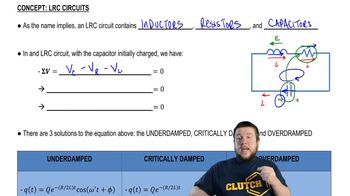
An RLC circuit is an electrical circuit that consists of a resistor (R), inductor (L), and capacitor (C) connected in series or parallel. The behavior of the circuit is influenced by the frequency of the applied voltage, which affects the reactance of the inductor and capacitor. Understanding the impedance of the circuit, which combines resistance and reactance, is crucial for analyzing power consumption and phase relationships in AC circuits.
Recommended video:

Power Factor

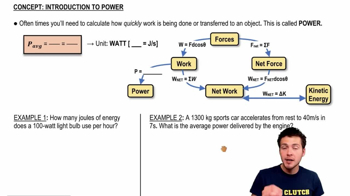
The power factor is a dimensionless number between 0 and 1 that represents the ratio of real power (used to do work) to apparent power (total power in the circuit). It indicates how effectively electrical power is being converted into useful work output. A power factor of 1 means all the power is being effectively converted, while lower values indicate inefficiencies, often due to reactive components like inductors and capacitors.
Recommended video:

Real Power and Apparent Power

Real power, measured in watts (W), is the actual power consumed by the circuit to perform work, while apparent power, measured in volt-amperes (VA), is the product of the circuit's voltage and current. The relationship between these two types of power is essential for calculating the power factor. In an RLC circuit, the presence of reactive components can lead to a difference between real and apparent power, affecting the overall efficiency of the circuit.
Recommended video: